After a collision, your vehicle deserves restoration that matches the precision of its original manufacturing. Modern cars leave assembly lines with exact structural measurements, calibrated safety systems, and multi-layered paint finishes engineered to last for years. At VMS Auto Collision Center in Covina, we’ve spent 35 years perfecting factory-quality restoration through computerized measurement systems, climate-controlled paint technology, and manufacturer-specific repair procedures.
Vehicle owners throughout Covina and nearby communities need an auto collision shop that delivers results matching original factory standards. This requires restoring structural dimensions to millimeter-level accuracy, recalibrating electronic safety systems, aligning body panels precisely, and matching paint while accounting for environmental exposure. Our I-CAR Gold Class certification and BBB A+ rating reflect our commitment to these exacting standards across every automotive collision repair we complete.
Understanding Factory-Specification Standards
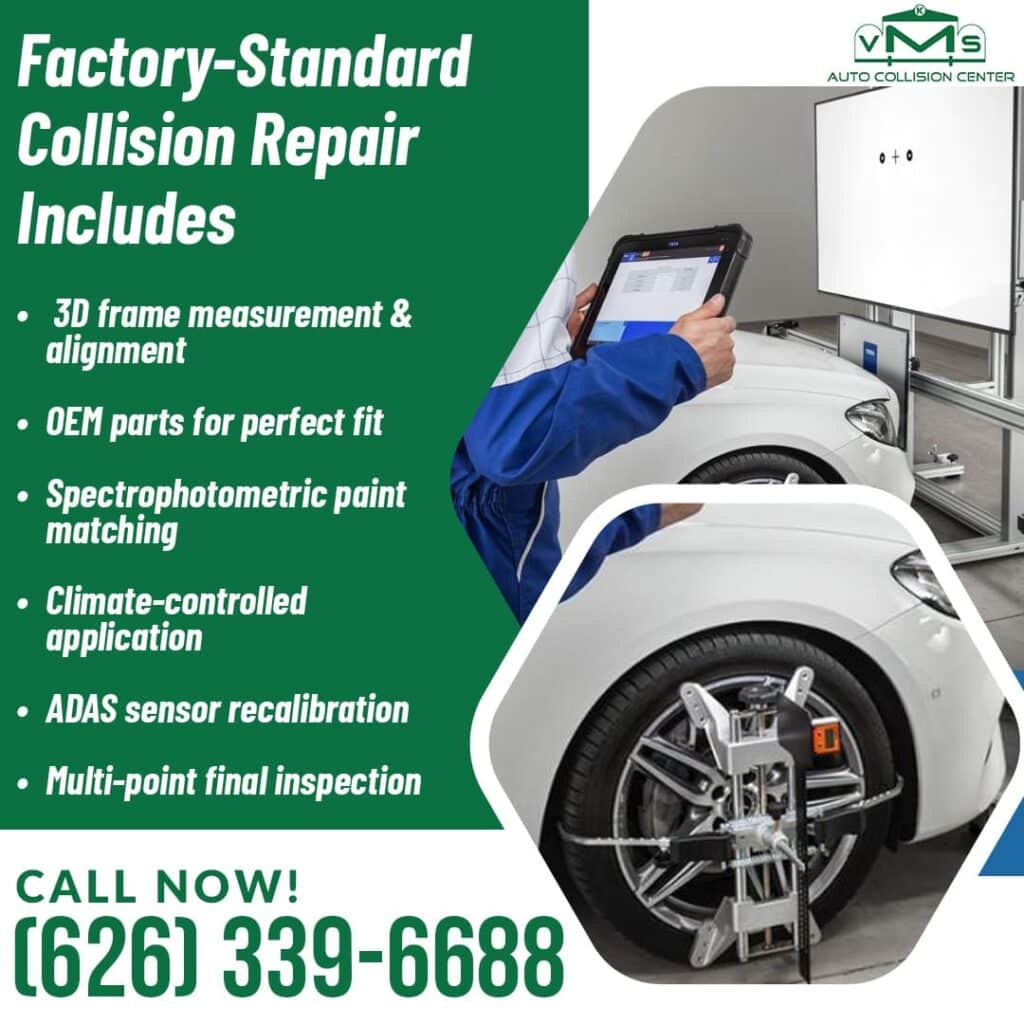
Factory specifications define precise measurements, materials, and procedures required to restore vehicle safety and performance. Manufacturers engineer vehicles with specific structural dimensions, part tolerances, and system calibrations that must be maintained through auto collision repairs.
Vehicle unibody construction integrates frame and body into a single structure designed to absorb crash energy while protecting occupants. This design requires millimeter-level accuracy during repairs because even small dimensional errors affect handling, tire wear, and crash protection.
Original Equipment Manufacturer (OEM) specifications provide the blueprint for proper repairs. These specifications include frame dimensions, torque values for fasteners, part replacement requirements, and calibration procedures for electronic systems. Professional facilities use these specifications rather than generic repair methods.
The difference between factory-quality work and basic bodywork appears in long-term vehicle performance. Properly repaired vehicles maintain original handling characteristics, safety system functionality, and structural integrity. Substandard repairs create problems that worsen over time.
Structural Assessment and Frame Alignment
Collision forces transfer through vehicle structures in complex patterns that can damage areas far from visible impact points. Professional assessment identifies all structural damage before auto collision repairs begin.
Computerized Measurement Systems
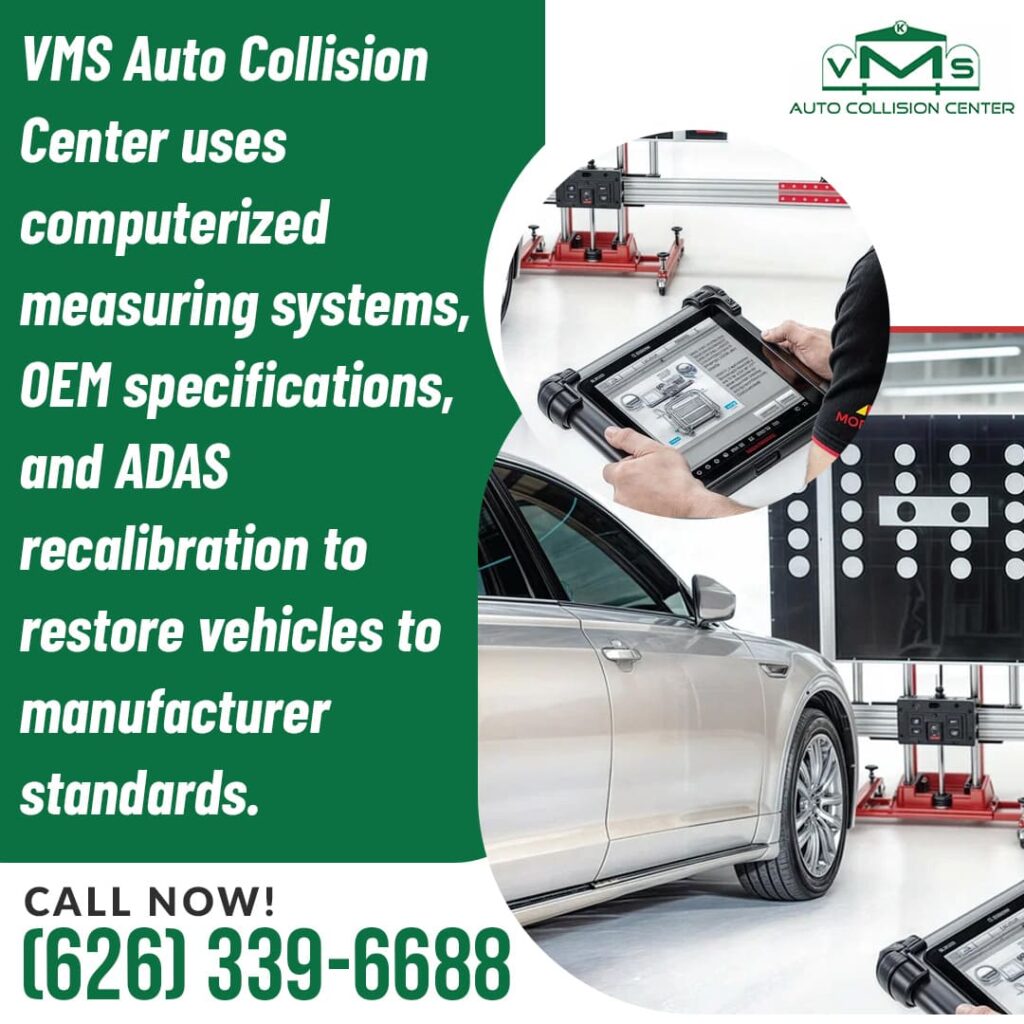
At VMS Auto Collision Center, we use computerized frame measuring systems that compare your vehicle’s current dimensions against manufacturer specifications. These systems measure multiple reference points simultaneously, creating a three-dimensional map of the vehicle structure.
Frame damage takes multiple forms depending on impact direction and severity. Frontal impacts often push frame rails rearward while creating vertical collapse. Side impacts can shift door openings and rocker panels laterally. Rear collisions affect trunk floor height and rear suspension mounting points.
Hydraulic Frame Straightening
The frame straightening process applies controlled force to bent structural members while monitoring dimensional changes in real time. Technicians make incremental adjustments, checking measurements after each pull to verify progress toward factory specifications. This gradual approach prevents over-correction that could weaken metal through excessive stress.
Modern vehicles use high-strength steel and aluminum alloys in structural components. These materials provide excellent crash protection but require specialized repair techniques.
| Material Type | Repair Considerations | Special Requirements |
| High-Strength Steel | Cannot be heated during straightening | Maintains engineered strength properties only with cold repair methods |
| Aluminum Alloys | Requires separate welding equipment | Demands different procedures and tools from steel construction |
| Traditional Steel | More flexible repair options | Standard welding and straightening techniques apply |
Each material demands specific knowledge and equipment. Our technicians receive manufacturer-specific training for working with these advanced materials.
Body Panel Repair and Replacement
Damaged body panels require assessment to determine whether repair or replacement provides the best results. This decision affects both repair quality and vehicle appearance.
Repair versus Replacement Assessment
Minor dents and creases often respond well to paintless dent repair or traditional metal finishing when the paint remains intact, and the metal has not stretched beyond acceptable limits. Technicians use specialized tools to massage metal back to its original contour without affecting the existing finish.
Severe panel damage may require replacement rather than repair. Panels with metal tears, extreme stretching, or multiple overlapping damage areas cannot be restored to factory contour through metal working alone. Attempting repairs on badly damaged panels creates rippled surfaces visible through paint.
Panel Installation and Alignment
Replacement panels must match original equipment specifications for proper fit and corrosion protection. We use OEM parts that maintain exact dimensions, mounting points, and material thickness as factory components. These parts include proper corrosion protection that aftermarket alternatives may lack.
Panel installation requires precise alignment before welding or fastening. Door gaps should measure consistently around the perimeter. Fender-to-door alignment affects how light reflects across body lines. Hood-to-fender relationships determine whether panel transitions appear smooth or create visible steps.
Parts Selection Impact on Quality
Component quality affects how repairs fit, function, and last over time. The parts installed during automotive collision repairs determine whether vehicles maintain factory standards or develop problems.
OEM Parts Advantages
OEM parts match original components exactly in dimensions, materials, and manufacturing quality. These parts maintain proper mounting points, bolt hole locations, and attachment interfaces required for correct assembly. Fit accuracy affects panel gaps, body line alignment, and how doors, hoods, and trunk lids operate.
Part warranties provide protection against defects or premature failure. OEM parts typically include manufacturer warranties covering materials and workmanship. These warranty differences affect long-term ownership when failures require replacement.
Aftermarket and Salvage Considerations
Aftermarket parts from reputable manufacturers can provide acceptable alternatives for some applications. However, quality varies widely among aftermarket suppliers. We evaluate aftermarket options carefully, discussing trade-offs with customers when alternatives are considered. Salvage parts removed from other vehicles carry unknown histories and potential hidden damage.
Paint Matching Technology and Application
Modern automotive finishes contain complex formulations that challenge simple color-matching approaches. Professional results require both advanced equipment and application expertise.
Spectrophotometric Color Analysis
We use spectrophotometric technology that measures color by analyzing light reflection across multiple wavelengths. This device creates a digital color profile compared against databases containing thousands of paint formulations from all vehicle manufacturers. The system accounts for color variations caused by production batch differences, sun exposure, and environmental factors.
Our auto collision shop uses Axalta paint products selected for their color accuracy, durability, and environmental resistance. These professional-grade refinishing materials contain higher pigment concentrations and advanced resins compared to consumer-grade products.
Climate-Controlled Application Environment
Climate-controlled paint booth application eliminates environmental variables affecting finish quality. Temperature and humidity control prevent drying problems that create texture defects or adhesion failures. Multi-stage air filtration removes dust particles that would otherwise settle on wet paint.
Metallic and pearl finishes present special challenges because their appearance depends on the effect of particle orientation within the paint film. Metallic flakes must lie at consistent angles to produce uniform color and sparkle. Pearl effects require precise particle concentration to match the color-shifting characteristics of original finishes.
Clear Coat and Finishing
Clear coat application provides the glossy appearance and environmental protection defining modern automotive finishes. Multiple thin coats build proper thickness while avoiding runs or texture problems. Color sanding removes minor surface imperfections, followed by polishing that restores mirror-like reflection quality.
Safety System Diagnostics and Verification
Modern vehicles contain electronic safety systems requiring diagnostic verification after automotive collision work. These systems protect occupants through features like automatic emergency braking, lane keeping assist, and adaptive cruise control.
Electronic System Diagnostics
Advanced Driver Assistance Systems (ADAS) rely on cameras, radar units, and ultrasonic sensors positioned throughout the vehicle. Even minor repairs near sensor locations can alter their aim or mounting position enough to cause malfunctions. Modern vehicles contain dozens of electronic control modules that communicate through data networks, and collision damage can disrupt these systems even when physical damage appears minor.
We perform diagnostic scans for sensors, cameras, and driver-assist systems before and after repairs to identify any electronic damage invisible during physical inspection. These scans retrieve fault codes from airbag modules, anti-lock brake systems, stability control, and ADAS features. The diagnostic process verifies that all systems communicate properly and contain no stored faults that could prevent proper operation.
Quality Control Verification Process
Our auto collision repair process includes multiple inspection stages where technicians verify work quality before vehicles advance to subsequent steps.
Multi-Point Inspection Standards
Frame measurement verification occurs after structural repairs to confirm that all dimensions meet manufacturer specifications. We document final measurements showing that the vehicle structure has been restored to factory tolerances.
Panel alignment inspection examines gaps and height relationships between all body components. Technicians verify that doors, hoods, trunks, and fenders sit flush with adjacent panels. Consistent gaps around openings indicate proper structural alignment beneath surface panels.
Paint Quality Assessment
Paint quality assessment occurs under multiple lighting conditions. Fluorescent lighting inside the shop reveals different aspects than natural sunlight or evening illumination. We examine repairs under various light sources to identify color variations or texture problems that might appear under specific conditions.
Final vehicle walkthrough with customers reviews all repair work before payment collection. We explain what repairs were performed, show documentation of parts and procedures used, and demonstrate that the vehicle functions properly.
Six Steps to Factory-Quality Restoration
VMS Auto Collision Center follows a structured six-step process for every vehicle that enters our facility. This systematic approach prevents oversights while maintaining consistent quality standards.
| Step | Process | What We Do |
| Inspection & Estimation | Damage Assessment | Assess all damage, including hidden problems. Computerized frame measurement identifies structural issues. Electronic scanning reveals safety system damage. |
| Auto Body Repairs | Structural Restoration | Straighten frame rails, repair or replace damaged panels, and restore proper structural dimensions. All work follows manufacturer repair procedures specific to your vehicle’s construction materials. |
| Painting | Color Matching & Application | Color-matching technology identifies the correct paint formulation. Climate-controlled booth application eliminates environmental variables. Multiple quality checks verify color accuracy and finish quality. |
| Reassembly | Parts Installation | Install OEM or certified parts, maintaining proper fit, finish, and safety standards. All components receive proper torque specifications during installation. |
| Quality Control | Final Inspection | Multi-point inspection examines frame dimensions, panel alignment, paint quality, and system functionality. Any issues discovered return to production for correction. |
| Detailing & Delivery | Customer Handover | Vehicles receive complete cleaning inside and out. Final walkthrough reviews all repair work with customers, answering questions and verifying satisfaction. |
Family Expertise Serving Covina Since 1989
VMS Auto Collision Center has provided services to the Covina community for 35 years. Our family ownership spans three generations, combining founder experience with current leadership and creating continuity in repair philosophy and business ethics that corporate chains cannot replicate.
Our I-CAR Gold Class certification demonstrates our commitment to ongoing education in collision repair technology. This industry recognition requires annual training for all repair personnel, covering new vehicle materials, repair procedures, and safety systems.
Our BBB A+ rating reflects consistent ethical business practices since accreditation began in 2019. Mazda Collision Network certification qualifies our facility to repair Mazda vehicles according to manufacturer specifications.
Limited Lifetime Warranty Protection
We stand behind our work with a Limited Lifetime Warranty covering all repairs performed at our auto collision shop. This warranty demonstrates confidence in our repair quality while providing customers with long-term protection.
The warranty covers workmanship and materials for as long as you own the vehicle. Paint finish, body panel repairs, and structural work all receive warranty protection.
Contact VMS Auto Collision Center
Professional automotive collision work requires advanced equipment, trained personnel, and systematic processes that address all aspects of vehicle restoration. Our facility combines these elements to deliver results meeting manufacturer specifications for safety, appearance, and performance.
Contact VMS Auto Collision Center at (626) 339-6688 or email info@vmsautocollision.com for a thorough damage assessment. Our team serves Covina and nearby areas with honest evaluations and quality work backed by our Limited Lifetime Warranty. We coordinate with insurance companies, arrange rental vehicles, and guide you through the entire repair process with transparency and professionalism.