The aftermath of an automotive collision brings an immediate wave of unfamiliar decisions, from figuring out which coverage applies to understanding what the repair process actually involves. Most people have never had to navigate a collision claim before, and the lack of familiarity with how it all works adds stress to an already difficult situation.
At VMS Auto Collision Center, we have been guiding Covina drivers through the auto collision repair and insurance process since 1989. As a family-owned business with over three decades of hands-on experience, we handle the insurance coordination, documentation, and communication so our customers do not have to. This guide draws on that experience to walk you through the key things every local driver should know about collision repair in Covina.
Types of Auto Insurance Coverage
Coverage type determines which repairs get paid for and who pays. Not all policies work the same way, and confusing one type for another leads to delayed repairs or unexpected out-of-pocket costs.
Collision Coverage
Collision coverage pays for repairs to your own vehicle after an accident involving another car or a stationary object, regardless of who was at fault. A sideswipe on the freeway, a rear-end impact at a stoplight, or a parking lot strike against a concrete barrier all fall under this coverage. This is the primary policy type that applies to most automotive collision situations.
Comprehensive Coverage
Comprehensive coverage applies to non-accident damage, including theft, vandalism, weather events, falling objects, and animal strikes. It does not cover collision damage. If a tree branch falls on your parked car, that is a comprehensive claim. If you hit a tree while driving, that is a collision claim.
Liability Coverage
Liability coverage is required by California law for all registered vehicles. It covers damage you cause to another person’s property or vehicle. It does not pay for repairs to your own car. If another driver is at fault for your accident, their liability coverage is what pays for your vehicle’s restoration.
Uninsured/Underinsured Motorist Coverage
Uninsured/Underinsured Motorist Coverage, commonly referred to as UM/UIM, applies when the at-fault driver carries no insurance or insufficient coverage to pay for your repairs. This coverage is especially relevant in hit-and-run situations or when the other party’s policy limits do not cover the full scope of damage.
Understanding Your Deductible
A deductible is the fixed dollar amount you pay out of pocket before your insurance covers the remaining repair balance. Deductibles only apply when you file through your own collision coverage, not when the at-fault driver’s liability insurance is paying.
For example, if your repair bill comes to $3,500 and your deductible is $500, your insurer pays $3,000. If the other driver was clearly at fault and you file through their liability policy, you typically pay nothing out of pocket.
One related term worth knowing is subrogation. This is the process by which your insurance company recovers money from the at-fault party’s insurer after paying your claim. If subrogation is successful, you may receive your deductible reimbursed.
Your Legal Rights as a California Driver
Under California law, you have the right to choose any licensed auto collision shop for your repairs. Your insurer cannot require you to use a specific facility.
This is established under California Insurance Code Section 758.5 and reinforced by the California Auto Body Repair Consumer Bill of Rights, which states that an insurance company shall not require repairs to be done at a specific auto body repair shop.
Your insurer may suggest preferred or “direct repair” shops. These are facilities with which the insurer has cost-sharing agreements. These recommendations can only be made if you ask for one, and only after notifying you in writing that using their suggested shop is optional. If you feel pressured to use a specific facility, you may file a complaint with the California Department of Insurance.
Three Rights Every Covina Driver Should Know
California law gives vehicle owners specific protections during the auto collision repair process. These rights apply regardless of which insurance company is involved or which shop you choose.
- You do not need multiple estimates. California law requires only one written estimate, from the shop you choose, before repairs begin.
- Non-OEM parts must meet OEM quality standards. OEM stands for Original Equipment Manufacturer, meaning parts made by your vehicle’s maker. If aftermarket parts are used, they must be equal in fit, performance, and safety to the originals. The shop must notify you and obtain your approval before using them.
- You must receive a written estimate and an itemized invoice. No repair work can proceed without your written authorization based on a detailed cost breakdown.
How the Insurance Claim Process Works
The claim process follows a defined sequence. Knowing each stage in advance prevents delays and protects your interests throughout the repair.
Step 1: Document and Report
After an accident, document the scene thoroughly. Photograph all vehicle damage, road conditions, and the surrounding area. Collect the other driver’s name, license number, insurance company, and policy number. Contact your insurance company promptly. Avoid discussing or admitting fault at the scene, even if you believe you may be partially responsible.
Step 2: Adjuster Assignment and Initial Estimate
Your insurer assigns a claims adjuster to assess your vehicle and create an initial repair estimate. This estimate is typically based on a visual inspection and software tools. It often does not capture hidden or structural damage that only becomes visible during disassembly at a collision repair shop.
Step 3: Choosing Your Shop
Select a certified auto collision shop before repairs begin. The shop you choose, not the insurer, will conduct the thorough technical inspection that identifies all damage, including what the adjuster may have missed on the surface.
Step 4: Supplemental Damage Discovery
Once disassembly begins, additional damage that was not visible externally often surfaces. A qualified shop documents this and submits a supplemental claim to your insurer for approval before continuing work. Supplemental approvals typically take 24 to 72 hours, though damage complexity and insurer response times vary.
Step 5: Parts Ordering and Verification
Once all authorizations are in place, parts are ordered. Reputable shops verify incoming parts against order specifications before accepting shipments. This step prevents installation delays caused by incorrect or damaged components arriving from suppliers.
Step 6: Repairs, Quality Inspection, and Delivery
Repairs proceed according to the manufacturer’s specifications. Before notifying you for pickup, a thorough quality inspection covers structural alignment, panel fit, paint quality, and electronic system function. You should not be asked to make a payment until a full walkthrough of completed work has been completed.
Two Insurance Terms That Affect Your Settlement
Betterment
Betterment is a reduction in your insurance settlement applied when new replacement parts improve your vehicle’s condition beyond its pre-accident state. It most commonly applies to worn components such as tires, batteries, or brake parts, where a new replacement represents an upgrade over what was there before the accident.
For example, if your tires had 40,000 miles on them and the accident required replacement with new tires, your insurer may reduce the settlement to reflect the remaining useful life that was already consumed before the crash.
Diminished Value
Diminished value refers to the reduction in your vehicle’s resale market value that persists even after professional repairs, because accident history affects what buyers are willing to pay. California’s rules on collecting diminished value from your own insurer are limited. However, if another driver was at fault, you may be able to pursue a diminished value claim against their liability coverage.
Both terms are worth understanding before you review or accept a settlement offer from your insurer.
Rental Car Coverage During Repairs
California law requires your insurer to inform you in writing whether your policy includes rental car coverage, the daily rate they will pay, and the maximum number of covered days.
Rental coverage typically runs for the approved duration of your automotive collision repairs. Standard policies cap coverage at a daily dollar amount, which may not cover the full cost of a comparable replacement vehicle. Reviewing your policy limits before an accident gives you accurate information for planning.
In situations where insurance rental coverage does not apply, for instance, when the at-fault driver’s insurer is disputing liability or your deductible exceeds the repair total, working with a shop that has established relationships with rental providers simplifies temporary transportation arrangements considerably.
How a Certified Auto Collision Shop Supports Your Claim
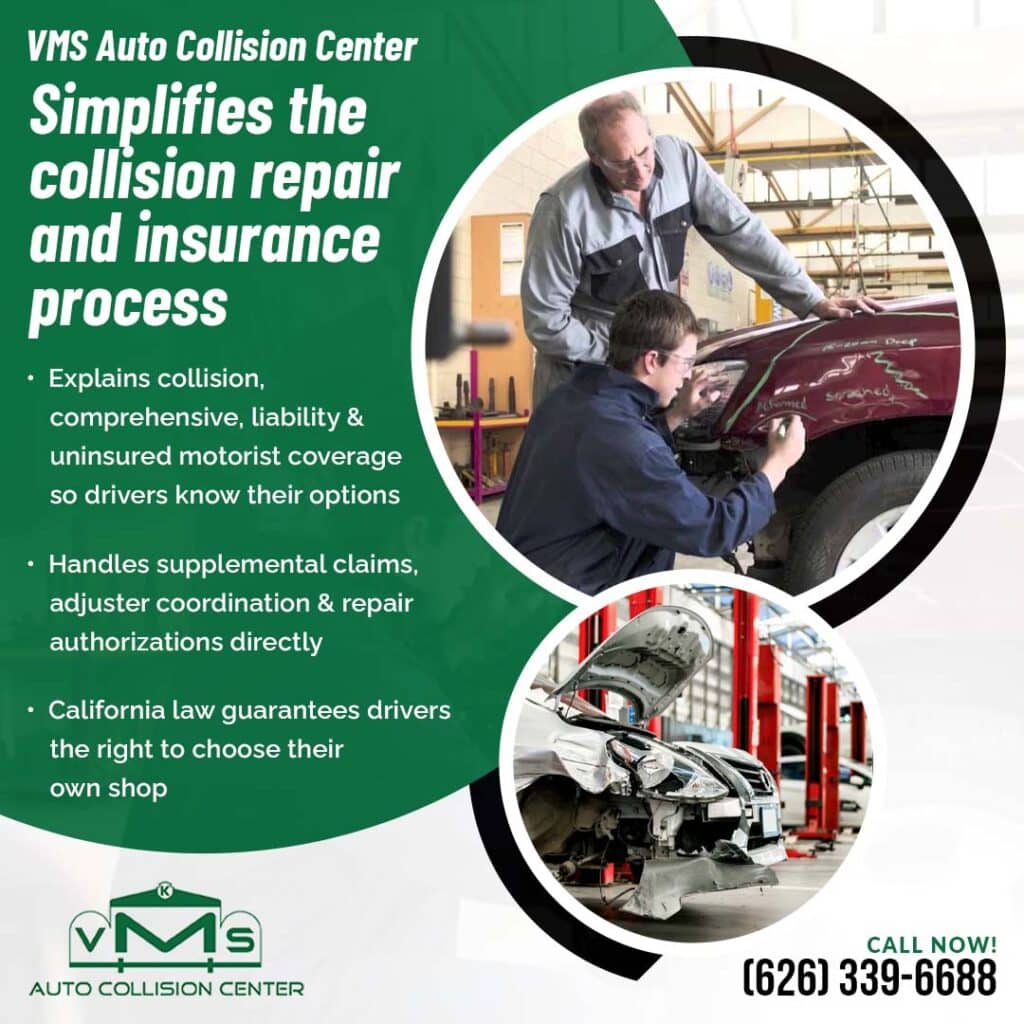
A certified auto collision shop does more than restore your vehicle. It manages the technical and administrative side of your insurance claim, communicating directly with your adjuster, submitting repair documentation, and advocating for the correct scope of work when an insurer’s estimate falls short.
Under California’s Fair Claims Settlement Practices Act, your insurer must either pay the difference between their estimate and the shop’s documented figure or provide another facility where the full repair can be completed for the approved amount. A shop experienced in working with insurers removes you from that negotiation entirely.
Three Areas Where Shop Involvement Makes a Difference
- Hidden damage documentation. Shops use computerized frame measurement systems and electronic diagnostic scanning to identify structural and sensor damage that is invisible during a standard visual inspection. This documentation is what supports supplemental claim approvals.
- Parts qualification. Experienced shops recognize when insurer-specified aftermarket parts do not meet California’s quality standards and can provide documentation to require OEM-equivalent replacements instead.
- Timeline management. Direct communication between the shop and adjuster shortens the back-and-forth that typically delays claim authorization and parts ordering.
Certifications That Matter When Choosing a Shop
Not all auto collision repair facilities operate at the same technical standard. Third-party certifications provide objective, verifiable evidence that a shop meets defined criteria for training, equipment, and repair quality.
I-CAR Gold Class
I-CAR Gold Class is the collision repair industry’s highest training designation. I-CAR stands for Inter-Industry Conference on Auto Collision Repair. This certification requires ongoing annual training across all shop roles, including estimators, technicians, and support staff. Training covers current vehicle materials, repair procedures, and safety system restoration. Shops that maintain Gold Class status demonstrate a commitment to continuous education rather than one-time certification.
BBB Accreditation and Rating
BBB Accreditation, where BBB stands for Better Business Bureau, reflects a consistent record of ethical business practices, timely complaint resolution, and accurate advertising. An A+ rating is the highest the BBB awards, indicating the business meets all evaluation criteria across complaint history, licensing compliance, and transparency.
Manufacturer Network Certifications
Manufacturer network certifications indicate that a shop has met a specific automaker’s facility, equipment, and training standards. Vehicles repaired at a manufacturer-certified shop are restored to the factory specifications relevant to that brand’s construction materials and safety systems.
When selecting a shop for collision repair in Covina, these credentials are factual starting points for comparison, not self-reported marketing claims.
How VMS Auto Collision Center Handles the Process
VMS Auto Collision Center has been a family-owned business in Covina since 1989, now operating across three generations. Over that time, we have helped drivers work through the collision repair and insurance process with clear communication and consistent results.
Insurance Coordination From Start to Finish
After an accident, our team reviews the damage with you, prepares a detailed repair estimate, and submits it directly to your insurance adjuster. We handle the back-and-forth communication so you are not left chasing approvals or decoding adjuster responses.
If hidden damage surfaces during disassembly, we document it thoroughly and submit a supplemental claim to your insurer before any additional work begins. Every step is communicated to you in clear terms.
Rental Car Assistance
If your policy includes rental coverage, we coordinate directly with Enterprise and other providers to arrange transportation while your vehicle is in our care. For situations where rental coverage does not apply, our team helps identify available options to keep you mobile during the repair period.
Six-Step Repair Process
At VMS Auto Collision Center, repairs follow a structured six-step process designed to restore every vehicle to its pre-accident condition: inspection and estimation, auto body repairs, painting, reassembly, quality control, and detailing and delivery. Each stage follows manufacturer repair specifications, and no vehicle leaves our facility without passing a thorough quality inspection first.
Our Warranty and Certifications
Every repair performed at VMS Auto Collision Center is backed by a Limited Lifetime Warranty for as long as you own the vehicle. Our facility holds I-CAR Gold Class certification, a BBB A+ rating accredited since 2019, and manufacturer network certification. These credentials reflect the training standards and repair quality we maintain across every job, regardless of vehicle type or damage severity.
Collision Repair in Covina with Full Insurance Support
If your vehicle has been involved in an accident, the first step is a thorough inspection at a qualified automotive collision shop, not a quick visual review, but a full assessment that accounts for structural, electronic, and mechanical systems before any work begins.
Contact VMS Auto Collision Center at (626) 339-6688 or email info@vmsautocollision.com to schedule your inspection and get started with collision repair in Covina.