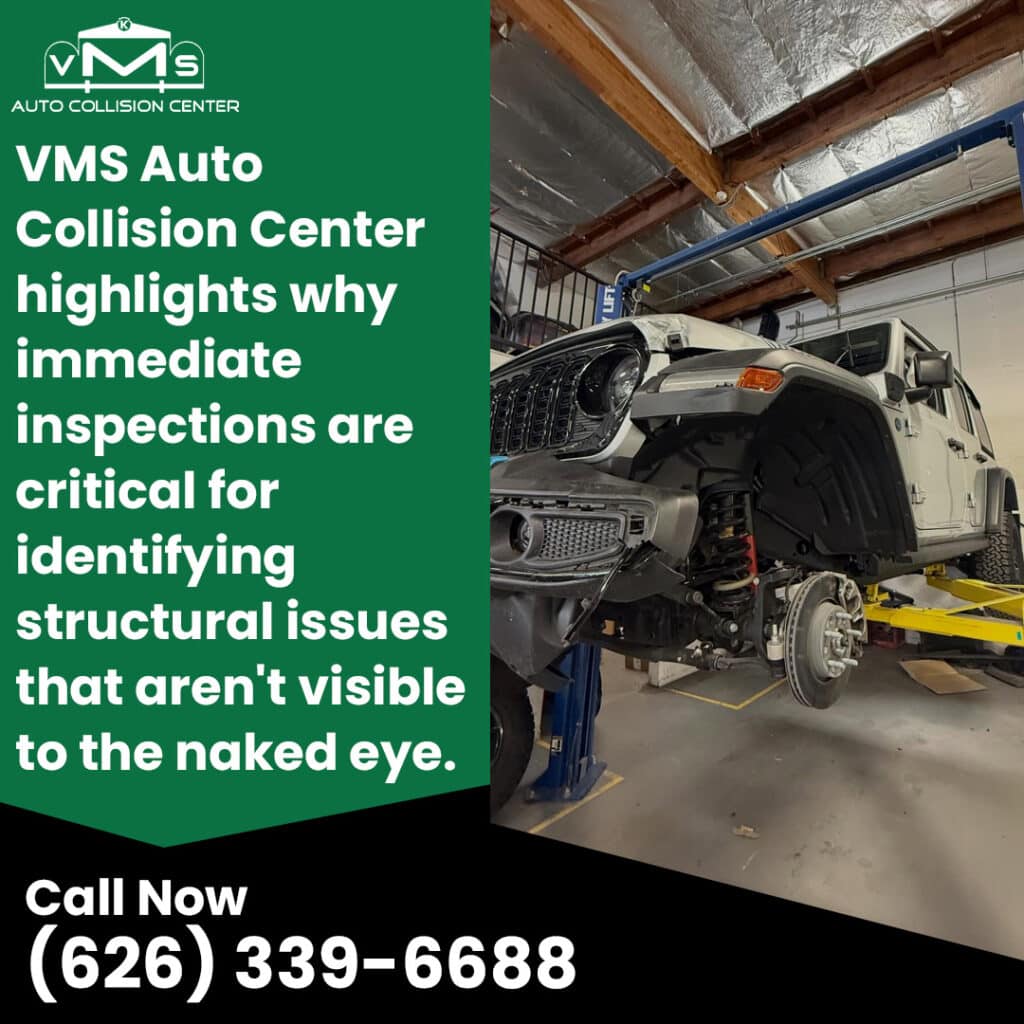
Most drivers walk away from a collision focused on what they can see. A cracked bumper, a dented panel, a scuffed door. What they don’t see is the structural stress transferred to the frame, the suspension components knocked out of position, or the paint barrier broken just enough to let moisture in. Every day that passes without a professional assessment gives that hidden damage more time to develop into a larger, more involved repair.
VMS Auto Collision Center has been serving drivers in Covina and surrounding communities since 1989. Built on a foundation of family ownership and multi-generational craftsmanship, our auto collision shop handles the repair process from initial assessment through insurance coordination and final delivery. Understanding why speed matters after a collision is the first step toward protecting your vehicle, your claim, and your safety on the road.
What Happens When You Delay Collision Repair
Delaying repairs allows initial damage to progress into more involved structural and mechanical problems. What appears minor on the surface often conceals deeper structural stress. A rear-end impact, for example, can push the trunk floor out of alignment and shift the rear suspension mounting points. This type of damage only becomes apparent through computerized frame measurement, not visual inspection alone.
Consequences of Putting Off Repairs
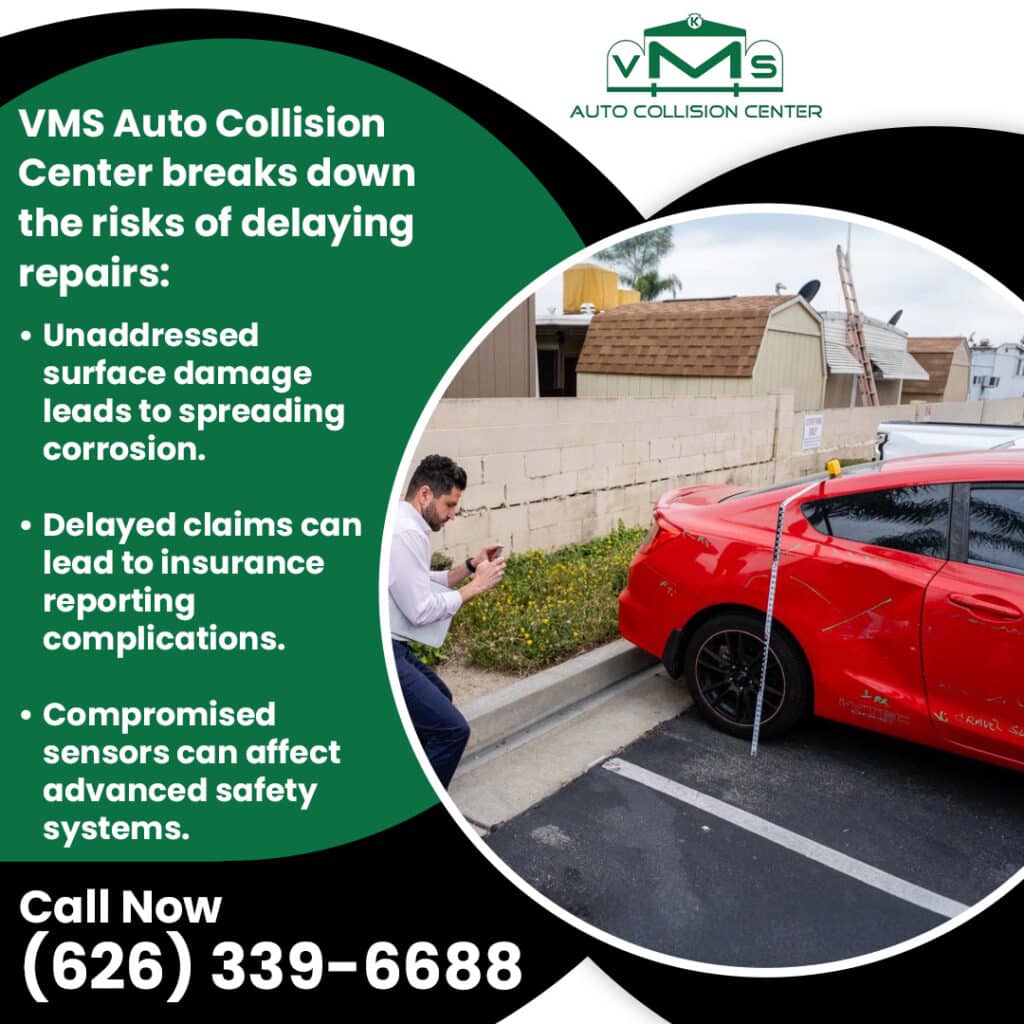
Delaying collision repairs sets off a chain of consequences that affect your vehicle in three key ways.
- Damage spreads to nearby components. A small dent in a door panel creates a stress point in the surrounding metal. Daily driving, vibration, temperature changes, and road flex cause that stress to spread outward. What starts as a localized repair can evolve into a more involved process affecting adjacent panels and structural supports.
- Exposed metal invites corrosion. Every chip, scratch, or dent that breaks through the paint exposes bare metal to air and moisture. Once rust forms, it does not stay in one spot. It advances beneath the paint surface, weakens surrounding panels, and can eventually compromise the structural integrity of the vehicle if left untreated.
- Insurance claims become harder to support. The longer a damaged vehicle sits without documentation or a professional assessment, the more room an adjuster has to argue that additional damage came from a separate event rather than the original auto collision. Acting quickly preserves the accuracy and completeness of your claim.
California Reporting Deadlines Drivers Need to Know
California law sets specific reporting windows after any collision involving injury or significant property damage.
Under California Vehicle Code § 16000, if an accident results in more than $750 in property damage or causes injury to any person, the driver must file a Traffic Accident Report (Form SR-1) with the California Department of Motor Vehicles within 10 days of the collision.
On the insurance side, most California auto insurance policies require prompt notification, typically within 24 to 72 hours of the incident. Failure to notify your insurer within the required window can result in delayed claim processing or a denial of coverage, even for legitimate claims.
Once a claim is filed, California law requires insurers to acknowledge it within 15 days and issue a coverage decision within 40 days of receiving all required documentation. The sooner you report and begin the process, the sooner your vehicle can be properly assessed and restored.
How Unrepaired Damage Creates Safety Risks
Unrepaired collision damage can reduce a vehicle’s ability to protect occupants in a subsequent accident.
Modern vehicles are built around interconnected safety components. Crumple zones, which are areas of the vehicle engineered to absorb and redirect crash energy during an impact, depend on structural integrity to perform correctly. When frame rails or unibody sections are bent and left uncorrected, that system is compromised. In a second impact, the vehicle may not respond the way its engineers intended.
Structural Damage
The unibody, which is the single-piece frame structure used in most modern passenger vehicles, is built to specific dimensional tolerances. Even a shift of a few millimeters in the frame can affect how the vehicle handles, how the doors align, and how crash energy moves through the body during a future impact. This type of damage is not visible without computerized frame measurement equipment.
Suspension and Alignment Deterioration
Collision forces can displace suspension components, including control arms, tie rods, and subframe mounting points, from their factory positions. When suspension geometry is altered, tires wear unevenly, handling becomes less predictable, and components like wheel bearings and ball joints wear out ahead of schedule. These are mechanical issues that worsen with every mile driven on an unrepaired vehicle.
Safety System Disruption
Advanced Driver Assistance Systems, commonly referred to as ADAS, include features like automatic emergency braking, lane departure warnings, and backup cameras. These systems depend on sensors and cameras mounted throughout the vehicle’s exterior. An auto collision can physically shift or damage these sensors without any visible sign of a problem. The system may appear to function normally while delivering inaccurate data, creating a false sense of security during everyday driving.
Delayed Repairs and Their Impact on Resale Value
Unrepaired auto collision damage lowers a vehicle’s resale value and raises concerns for buyers and appraisers.
Vehicle history reports, such as those generated by CARFAX, document accident involvement alongside repair records. A vehicle that shows accident history with no corresponding professional repair documentation signals neglect to prospective buyers. Dealerships and private buyers factor this directly into their offers.
By contrast, a vehicle with documented repairs from a certified auto collision shop, including parts records, warranty information, and OEM (Original Equipment Manufacturer) parts usage, demonstrates that the vehicle was restored to manufacturer standards. This documentation protects resale value and gives buyers confidence in the vehicle’s condition and safety history.
Steps to Take Immediately After a Collision
Acting in the right order after a collision protects your safety, supports your insurance claim, and preserves your vehicle’s condition.
- Move the vehicle to a safe location away from traffic if it is drivable and turn off the ignition.
- Check all occupants for injuries. Call 911 if anyone requires medical attention.
- Exchange information with all drivers involved: full name, address, driver’s license number, license plate, and insurance policy details.
- Photograph all damage to every vehicle involved, the surrounding scene, and any relevant road or weather conditions.
- Do not discuss fault at the scene. Fault determination is handled through the formal claims process.
- Notify your insurance company promptly, as most California policies require notification within 24 to 72 hours.
- Schedule a professional vehicle inspection at a qualified automotive collision repair facility as soon as possible after the incident.
The VMS Auto Collision Center Approach to Automotive Collision Repair
VMS Auto Collision Center has provided collision repair in Covina since 1989. Founded as a family-owned business, we bring more than 35 years of hands-on repair experience across every vehicle type and damage category that Covina drivers face. That continuity means consistent repair standards grounded in the same values on which our shop was built at its founding.
Inspection and Damage Assessment
Every vehicle we receive begins with a full damage assessment using computerized frame measurement systems. This technology identifies structural shifts that are not visible to the eye. Electronic diagnostic scanning follows, checking all safety systems, sensors, and control modules for automotive collision damage before any repair work begins.
This process serves two purposes. It produces an accurate written estimate that explains every repair in plain language. It also generates the documentation your insurance company needs to authorize the work, which reduces delays and disputes during the claims process.
Insurance Claim Coordination
At VMS Auto Collision Center, we handle insurance communication directly, from submitting estimates to securing claim authorization, so you are not left managing that process on your own.
Our staff submits detailed estimates supported by photographs and diagnostic reports. We manage follow-up with adjusters and handle discussions over repair procedures and parts selection. For most clients, this removes the most stressful part of the process entirely.
Rental Vehicle Coordination
Transportation during repairs is a practical disruption that VMS Collision Center addresses through direct relationships with rental providers. If your insurance policy includes rental coverage, our staff verifies those benefits and coordinates vehicle pickup so your daily routine is not left on hold while repairs proceed.
Repair Process and Warranty
All repairs at VMS follow a six-step process: inspection and estimation, auto body repairs, painting, reassembly using OEM and certified parts, quality control, and a final detailing and delivery walkthrough. Paint refinishing uses Axalta products alongside a computerized color-matching system for accurate, durable results.
Every repair is backed by a Limited Lifetime Warranty covering workmanship and materials for as long as the vehicle remains in the owner’s possession.
Credentials That Define the Standards at Our Auto Collision Shop
VMS Auto Collision Center holds three industry certifications that verify our facility standards, equipment, and technician training.
- I-CAR Gold Class – Our team has earned and continues to maintain this designation, which, according to I-CAR, is held by only about 10 percent of collision repair facilities in the U.S., reflecting the annual training commitment it requires across all shop roles.
- BBB Accredited Business, A+ Rating – Accredited since 2019, we hold the highest rating available from the Better Business Bureau based on complaint history, licensing compliance, and transparency in service delivery.
- Mazda Collision Network Member – We are certified to repair Mazda vehicles to manufacturer specifications, meeting Mazda’s required equipment and facility standards.
Act Now to Protect Your Vehicle
The right time to have a collision-damaged vehicle inspected is as soon as possible after the incident. Hidden damage worsens with every day of regular driving. Corrosion advances once paint protection is broken. Insurance documentation becomes more complicated the longer a claim goes without a supporting professional assessment. From the initial inspection to final delivery, our process at VMS Auto Collision Center is designed to restore your vehicle accurately, keep you informed at every stage, and take the burden of insurance coordination off your hands.
Contact our team at (626) 339-6688 or info@vmsautocollision.com to schedule your damage assessment and experience trusted collision repair in Covina from a shop that has served this community since 1989.