Getting into a collision turns an ordinary day upside down fast. Between the insurance calls, the rental car situation, and the question of whether your car is even safe to drive, the last thing you want is to make the wrong call on where to take it. Most drivers default to the dealership out of familiarity, which is a reasonable instinct. But collision repair is a specialized trade, and understanding what separates a dedicated collision facility from a dealership service department helps you make a more informed decision for your specific situation.
VMS Auto Collision Center has been providing auto body repair in Covina since 1989. What started as a family-owned business has grown into a multi-generational operation with over 35 years of hands-on collision repair experience behind every job. As an I-CAR Gold Class certified auto body shop, we work directly with all major insurance companies, coordinate rental car arrangements, and back every repair with a Limited Lifetime Warranty. This article walks through the real differences between a local certified collision shop and a dealership, so you can make a confident, informed decision about where your vehicle gets repaired.
Collision Repair Is a Separate Trade from Mechanical Service
Dealership service departments are built around mechanical repairs. Oil changes, engine diagnostics, warranty service, and manufacturer recalls are what their teams, bays, and daily schedules are designed for. That is not a limitation. It is simply what they specialize in.
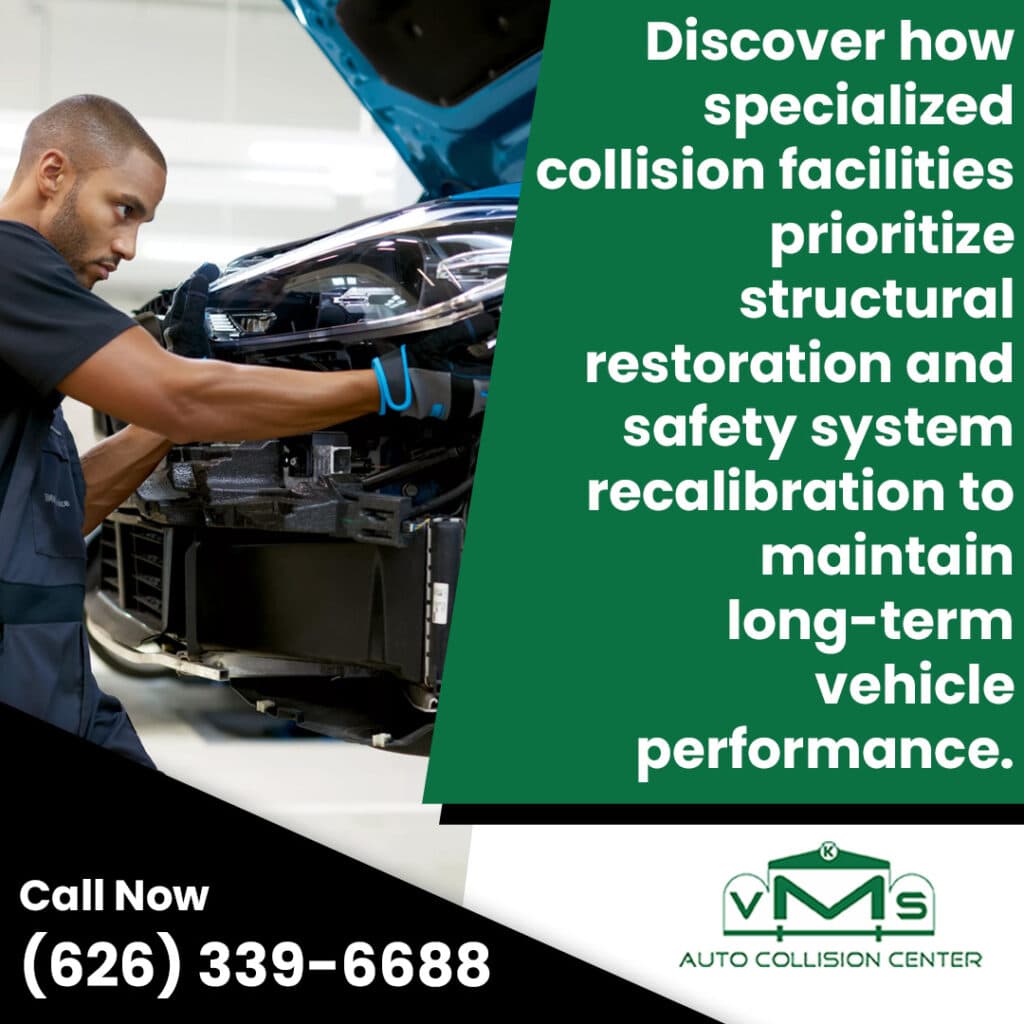
Collision repair is a different trade. It requires its own equipment, facility certifications, and technicians trained specifically in structural restoration, refinishing, and safety system recalibration. When a dealership excels at mechanical service, it does not automatically mean its collision department operates at the same level.
How Dealerships Handle Body Work
Some dealerships have fully equipped collision departments with trained staff on site. Others route vehicles to a partnered third-party facility. If your vehicle is sent off-site, it is worth asking where it is going, who will be working on it, and whether that facility holds current industry certifications.
The main practical difference at dealerships that use outside shops is communication. Updates tend to pass through a service writer rather than coming directly from the repair team. If you have specific questions about a repair decision or a part that was used, getting a clear answer may take an extra step or two.
What a Dedicated Collision Facility Covers
A dedicated auto body repair service is built exclusively around restoring vehicles after collisions. Structural frame correction, panel repair, paint refinishing, bumper restoration, and recalibrating the electronic safety systems displaced during impact are the core functions of the business.
That focused operation produces more accurate and consistent outcomes than a department where collision work is secondary to mechanical service volume.
Technician Certification and Training
A common assumption is that dealerships have better-trained technicians because of their manufacturer affiliation. In practice, technician quality at any auto body shop comes down to certification, not the name above the door.
Certification Is the Shared Standard
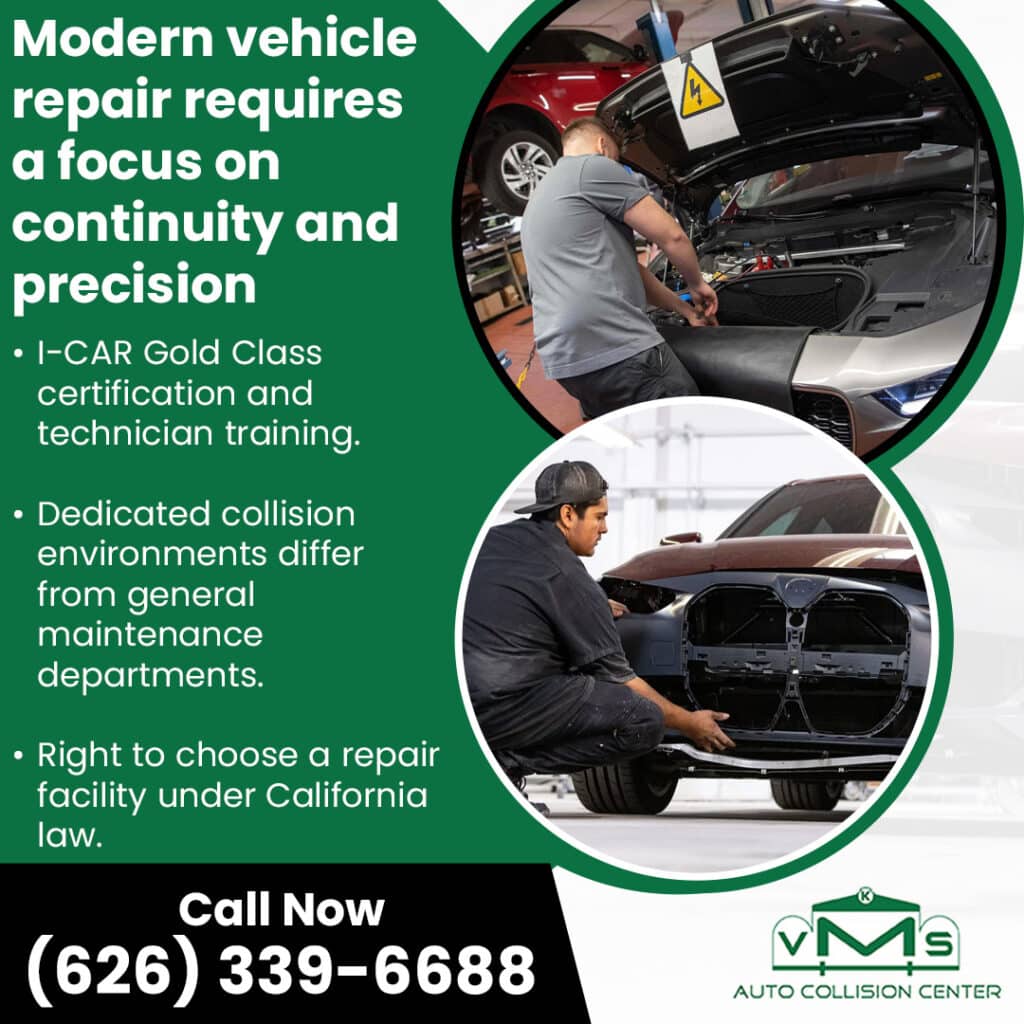
I-CAR, which stands for the Inter-Industry Conference on Auto Collision Repair, sets the training standards for the collision repair industry. Their Gold Class designation requires ongoing annual training for all repair roles, covering modern vehicle materials, manufacturer repair procedures, and safety system calibration. Both certified dealership collision departments and certified independent shops are held to this same standard.
A local auto body shop in Covina that holds I-CAR Gold Class certification operates under the same professional benchmark as a certified dealership facility. The training requirements are identical. When evaluating any shop, confirming that they hold current I-CAR Gold Class certification is one of the most reliable ways to verify that technicians are trained to work on modern vehicles correctly.
VMS Auto Collision Center holds I-CAR Gold Class certification, meeting the same standard required of qualified dealership collision departments.
Manufacturer Network Membership
Some independent shops pursue additional manufacturer-specific programs on top of standard industry certifications. These programs verify that a facility meets a manufacturer’s own repair and safety standards independently of general I-CAR requirements.
VMS Auto Collision Center is a member of the Mazda Collision Network, one such program. Our certified technicians apply manufacturer-appropriate procedures across all vehicle makes, not only Mazda models.
Structural Repair and Frame Accuracy
Frame accuracy is one of the most technically demanding parts of collision repair, and it is an area where the daily focus of a facility makes a real difference.
What Both Shop Types Use
Both certified dealership collision departments and certified independent body shops use computerized measuring systems that scan the full vehicle frame and compare results against manufacturer specifications.
Modern vehicles are built with specific crumple zones and structural geometry designed to direct collision energy away from occupants. If frame dimensions are not restored to exact tolerances, that protection is compromised even when the vehicle looks correct from the outside. Subtle shifts in suspension mounting points cause uneven tire wear, steering pull, and reduced protection in a future crash. None of those deviations shows up in a visual inspection.
Where the Difference Lies
The distinction is not the equipment itself, but how consistently it is used. Shops whose entire operation centers on collision repair tend to apply frame measurements at multiple stages rather than only at the start or end. That consistency reduces the chance of a deviation going undetected before delivery.
For customers seeking auto body repair in Covina, this documented accuracy is part of every repair we complete at VMS Auto Collision Center, not just complex jobs. Customers receive a pre-repair and post-repair measurement record confirming the vehicle was restored to factory specification, which also protects resale value and supports lease return requirements.
ADAS Calibration After Collision Damage
ADAS stands for Advanced Driver Assistance Systems. This covers the electronic safety features most drivers rely on daily: automatic emergency braking, lane keeping assistance, blind spot monitoring, and adaptive cruise control. After a collision, both dealerships and independent auto body shops need to address these systems, but the consistency of that process can vary.
Why This Step Gets Missed
These systems rely on cameras, radar units, and ultrasonic sensors mounted throughout the exterior. Collision damage, even something minor, can shift those sensors enough to cause problems. Replacing a windshield moves the forward-facing camera. Bumper repairs change radar sensor angles. Warning lights may clear after a repair without confirming that the systems are working within factory parameters.
Dealerships with dedicated collision departments generally have the diagnostic equipment for ADAS calibration. The concern with any facility is whether calibration is treated as a standard step or skipped when warning lights clear on their own.
A 2017 study published in Accident Analysis & Prevention and cited by the Insurance Institute for Highway Safety (IIHS) found that vehicles equipped with both forward collision warning and automatic emergency braking reduced rear-end striking crash involvement rates by 50%. Those results depend on those systems being correctly positioned and calibrated after any repair that affects them.
How Certified Collision Shops Handle Calibration
Certified collision shops treat ADAS calibration as a required step, not an optional one. Specialized targets and manufacturer-specific diagnostic equipment reset sensors to the factory position before the vehicle is returned. At VMS Auto Collision Center, calibration is part of our standard quality control process for every repair involving sensor-bearing components.
Paint Matching and Refinish Quality
Paint quality is one of the most visible differences between an auto body repair done well and one that falls short. Both dealership collision departments and independent body shops use paint-matching technology, but investment in equipment and controlled application conditions varies between facilities.
Where Results Diverge
Most vehicles more than a couple of years old have paint that has faded or shifted from years of sun exposure. Factory codes identify the original formula but do not account for that change. Mixing paint from the code alone often looks close in the shop but noticeably wrong in direct daylight. Metallic, pearl, and tri-coat finishes make this worse.
Dealerships running high-volume service operations sometimes prioritize throughput over precision in the refinishing process. A dedicated auto body repair service focused exclusively on collision work tends to invest more in the equipment and controlled conditions that produce consistent, seamless results.
At VMS Auto Collision Center, we pair computerized color matching with Axalta paint products, a professional-grade refinishing brand used by certified facilities nationwide. All paint work is completed in climate-controlled booths that maintain consistent temperature and humidity throughout application, preventing texture problems, contamination, and adhesion failures that appear weeks later in repairs where the environment is not managed carefully.
Insurance Claim Handling
California law gives vehicle owners the right to choose any licensed repair facility for their collision claim. The California Department of Insurance confirms that insurers cannot require customers to use specific shops or preferred provider networks.
Insurance Coordination at Dealerships
Dealership service departments frequently place insurance coordination back on the customer. You file the claim, communicate with the adjuster, and bridge information between the insurer and the shop. Each step adds time and requires follow-up on your end throughout the repair process.
How Independent Shops Handle the Process
Shops with dedicated claims experience handle filing, adjuster scheduling, damage documentation, and supplement requests on your behalf. Established insurer relationships mean documentation is structured correctly from the start, reducing the approval delays that extend repair timelines.
At VMS Auto Collision Center, our team manages the complete claims process for every customer. With over 35 years of direct insurer relationships, drivers seeking auto body repair in Covina can focus on getting back on the road rather than managing paperwork.
Warranty Coverage on Collision Repairs
Warranty terms reflect how confident a facility is in the quality of its work.
Dealership Warranty Terms
Dealership body departments typically offer one- to three-year warranties on labor and parts. Coverage terms vary by location and manufacturer guidelines. The fine print often excludes paint adhesion issues, limits coverage to specific parts categories, or fixes the coverage period by time, regardless of the nature or extent of the repair. Once that window closes, any follow-up costs fall to the vehicle owner.
Independent Shop Warranty Terms
Independent certified collision shops vary in how they structure warranty coverage, but many use their terms as a direct reflection of their repair standards. Shops confident in their workmanship and materials tend to offer longer coverage periods. Some provide warranties that extend for as long as the customer owns the vehicle, covering workmanship, paint adhesion, panel alignment, and structural repairs without a fixed expiration.
VMS Auto Collision Center provides a Limited Lifetime Warranty on all collision repair work for as long as you own the vehicle. If a defect in our work appears at any point during your ownership, corrections are made at no additional charge.
It is also worth noting that using a certified auto body shop in Covina for collision repairs does not affect your vehicle’s manufacturer’s warranty. The Magnuson-Moss Warranty Act, a federal consumer protection law, prevents manufacturers from voiding warranties solely because repairs were performed by an independent facility. Manufacturer warranties cover factory defects in materials or workmanship, not collision damage.
Choosing an Auto Body Shop in Covina
Both dealerships and certified independent collision shops can deliver quality repairs when they operate under verified training standards. The decision is less about the type of facility and more about what a specific shop brings to the table.
A shop that holds I-CAR Gold Class certification meets the same training benchmark regardless of whether it is dealership-affiliated or independently owned. One that offers a lifetime warranty stands behind its work longer than a fixed-term coverage period. One that manages insurance coordination directly reduces the administrative burden on the customer. One that has dedicated its entire operation to collision repair, day in and day out, brings a level of focused experience that a mixed-service department may not match.
Whichever direction you choose, verifying certification, warranty terms, and claims handling experience gives you a reliable basis for the decision.
Schedule Your Free Damage Assessment
Whether you need auto body repair services in Covina after a minor fender incident or a serious collision, VMS Auto Collision Center is ready to help. We serve Covina and the surrounding communities. Our I-CAR Gold Class certification, BBB A+ accreditation, Mazda Collision Network membership, and Limited Lifetime Warranty back every repair we complete.
Call (626) 339-6688 or email info@vmsautocollision.com to get started. Our team handles insurance coordination, rental car arrangements, and every step of the repair process so you can focus on getting back to normal.