
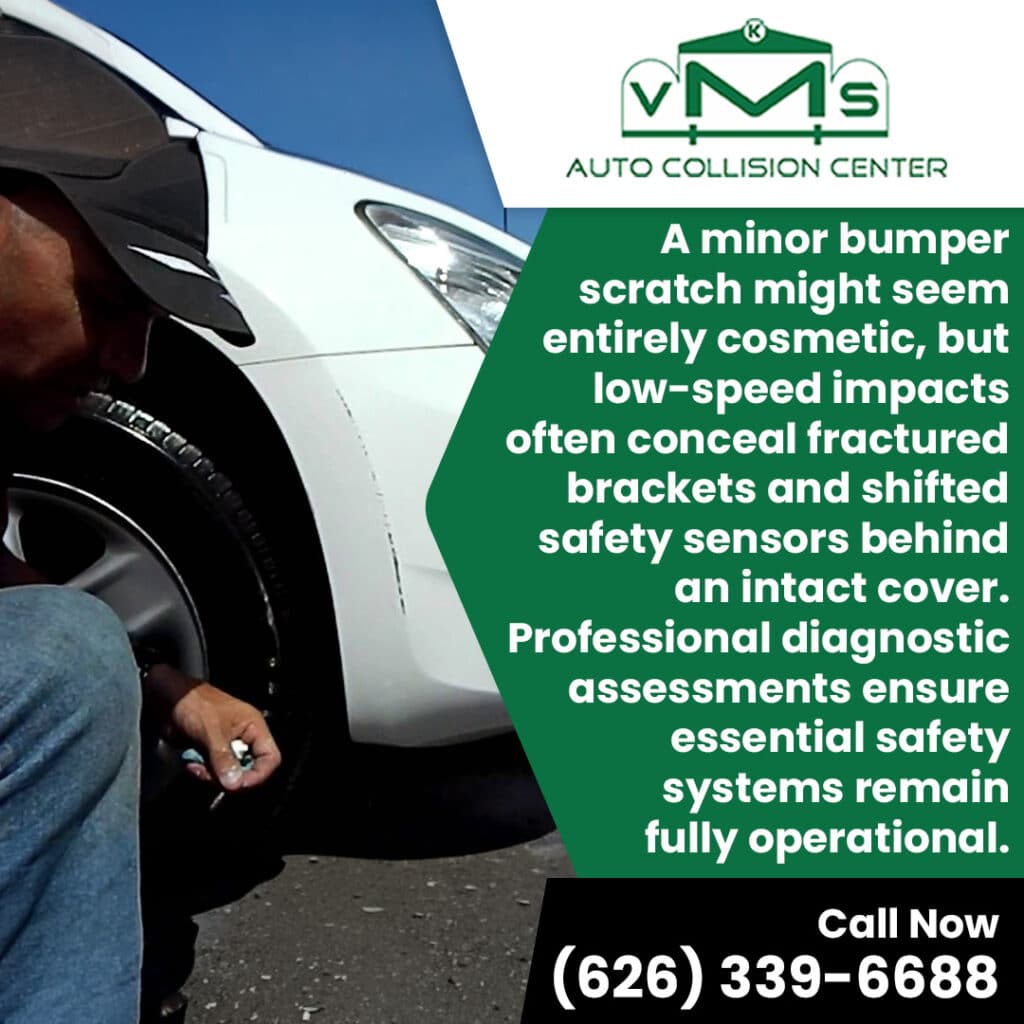
A bumper impact that leaves the car drivable tends to get deprioritized. There are no fluids leaking, no warning lights, and the vehicle handles the same as it did before. That combination of signals leads most drivers to a reasonable but incomplete conclusion: nothing serious happened. What it does not account for is that the bumper cover is designed to flex and return, which means the evidence of what actually occurred is hidden behind a surface that was engineered to look undamaged after minor contact.
VMS Auto Collision Center has operated as a family-owned auto body shop in Covina since 1989. The pattern we see consistently is that bumper damage left unaddressed does not stay the same. It compounds, either through a second impact on a system that can no longer absorb it correctly, or through sensor failures and moisture damage that develop over months of regular driving. This article covers the full picture: what a bumper is built to do, what goes wrong beneath the surface, what California law requires, and what a proper auto body repair involves from the first moment the cover is removed.
What a Bumper Is Actually Built to Do
A vehicle bumper is a load-bearing system designed to absorb collision energy before it reaches the frame, engine components, and occupants.
Federal regulation 49 CFR Part 581, the NHTSA (National Highway Traffic Safety Administration) bumper standard, establishes impact resistance requirements for passenger car bumpers in low-speed collisions. Under the standard’s protective criteria, bumpers are intended to reduce damage to the vehicle’s lamps, hood, doors, fuel system, cooling system, exhaust, and steering components during those impacts.
Three internal components carry that responsibility, and each one fails differently.
Reinforcement Bar
Behind the plastic cover sits a rigid steel or aluminum beam that runs the full horizontal span of the bumper. When a vehicle is struck, this bar takes the structural load and channels collision energy away from the frame. The cover can look untouched while this bar is bent. That combination of a clean exterior concealing damaged interior components is something our technicians encounter regularly on vehicles brought in for what owners describe as minor contact.
Energy Absorber
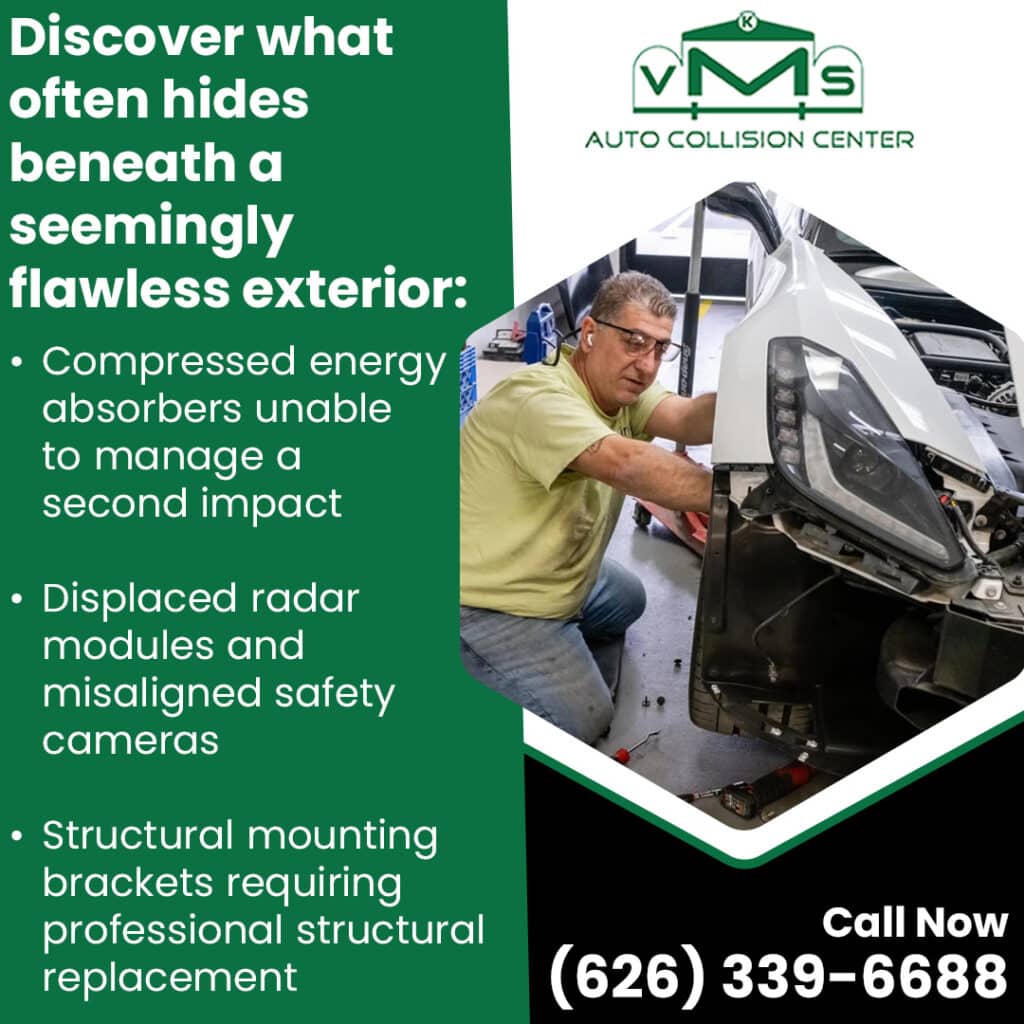
Between the cover and the reinforcement bar is a foam or plastic energy absorber. Its job is to compress during impact and slow the transfer of force into the vehicle structure. Once compressed, it stays compressed. There is no recovery. A bumper that has been in a single low-speed collision has an absorber working at a fraction of its original capacity, and nothing about its appearance will tell a driver that.
Mounting Brackets and Sensor Housings
Brackets and fasteners anchor the entire bumper assembly to the vehicle frame. A hard corner impact from clipping a concrete parking barrier or another vehicle’s rear corner can shear a bracket without producing obvious external damage. When a bracket fails, the bumper shifts position. On vehicles made in the last decade, that shift also moves the radar units and cameras housed in the bumper, pulling them away from the calibrated positions they need to function correctly. Identifying this type of concealed damage is precisely what separates a thorough auto body repair from a surface-level fix.
Gap Between What You Can See and What Is Actually Wrong
The outer shell of many modern bumpers is made from TPO, thermoplastic olefin, a material engineered to flex on impact and return to its original shape. That flexibility hides damage.
A cover that springs back after a low-speed contact tells the driver very little about what happened behind it. A mounting bracket may have separated from the frame. The reinforcement bar may be bent inward at the point of contact. A sensor housing may have rotated off its calibrated position. In each case, the vehicle continues to drive and handle normally, and nothing on the dashboard indicates that anything has changed.
What changes is how the systems connected to those components perform. A displaced sensor no longer reads from its intended position, which means the data it sends to the vehicle’s safety systems is inaccurate. In some cases, the system flags the error with a warning light. In others, it continues operating without any alert, producing outputs that the driver has no reason to question.
This is the pattern our auto body shop in Covina sees more often than not. The damage beneath the surface does not announce itself at the moment of impact. It surfaces later through a sensor fault, a warning that will not clear, or a safety feature that fails exactly when it is needed.
Safety Consequences of Leaving Damage Unaddressed
Weakened Crash Protection the Next Time
A bumper that has already absorbed a collision cannot absorb the next one at the same level. The energy absorber is permanently compressed. The reinforcement bar may carry stress fractures. Brackets that were partially dislodged offer a weaker attachment to the frame. Forces that an intact system would redirect away from the occupants instead transfer directly inward.
ADAS Sensors That Appear to Work But Do Not
ADAS is the collective name for Advanced Driver Assistance Systems, the electronic safety features built into most vehicles produced since 2015: automatic emergency braking, forward collision warning, blind spot monitoring (BSM), lane departure warning, and adaptive cruise control. All depend on cameras and radar units mounted in specific positions within the bumper structure.
When a collision shifts those positions, the systems relying on them produce incorrect outputs. A forward radar module angled a few degrees off its calibrated position may not detect a vehicle stopping ahead at the same distance it was designed to detect. The system does not flag this. The driver has no indication that the feature they depend on is operating with degraded accuracy.
A 2017 study found that vehicles equipped with both forward collision warning and automatic emergency braking reduced rear-end crash involvement by 50 percent. That reduction depends entirely on those systems functioning as calibrated. A misaligned sensor after a bumper impact is a direct threat to that protection.
Water Getting In Where It Should Not
A crack in the bumper cover is an entry point for moisture. Water reaches wiring harnesses and sensor connectors during rain and wet road conditions. Corrosion builds up on electrical contacts over time. The resulting faults start as intermittent issues, a sensor warning that clears on its own, a camera that hesitates, before becoming permanent failures that are difficult to trace because the water source dried long before disassembly.
Detached Sections Becoming Road Debris
A cover held in place by two or three remaining attachment points will eventually separate. Wind load at freeway speeds, vibration, and thermal expansion and contraction all work against what is left of the connection. When that section separates, it becomes road debris for anyone traveling behind. At surface street speeds, that is a collision risk. At freeway speeds on the 210 or 10, it is a serious one. What prevents that outcome is an auto body repair service that catches failing attachment points before separation occurs on the road.
What California Law Requires
California Vehicle Code Section 28071 requires every registered passenger vehicle in the state to be equipped with both a front bumper and a rear bumper.
The statute defines a bumper as any device designed to prevent the vehicle body from making direct contact with another vehicle. A vehicle operating without a functional bumper is subject to citation. Fine amounts vary by county.
There is also an insurance dimension most drivers are not aware of. When a vehicle has documented pre-existing bumper damage that was never repaired, and a subsequent collision occurs, previously documented damage can complicate future claims involving the same area of the vehicle and may affect how certain repair costs are evaluated.
Inside a Proper Bumper Repair at a Certified Auto Body Shop
Bumper repair at a certified auto body shop is not a cosmetic procedure. It is a structural and electronic restoration that begins with complete disassembly.
At VMS Auto Collision Center, no bumper repair begins from the outside. The cover comes off first. What follows depends on what the inspection finds, not on what the exterior looked like when the vehicle arrived.
Disassembly and Damage Documentation
With the cover removed, technicians inspect the reinforcement bar for bending and fractures, check the energy absorber for permanent compression, assess each mounting bracket against factory specifications, and trace all sensor wiring for pulled connections or corrosion. Every finding is documented before a single repair decision is made, which also produces an accurate scope of work for insurance purposes.
Structural Component Replacement
The reinforcement bar, energy absorber, and brackets are each evaluated against the manufacturer’s original specifications. Those that cannot be brought back to specification are replaced with OEM (Original Equipment Manufacturer) or OEM-equivalent components. Applying fresh paint over a permanently compressed energy absorber does not restore the bumper’s capacity. It only covers the evidence that the capacity is gone.
Sensor Recalibration
Any sensor or camera displaced during the collision is recalibrated using manufacturer-specific diagnostic software before the vehicle leaves the shop. This step determines whether the safety systems will function as designed after the repair. A bumper that passes a visual check but carries an uncalibrated forward radar module is a vehicle with a safety deficit that its driver cannot see.
Color-Matched Refinishing
Paint matching accounts for how the vehicle’s color has aged, not just the original factory formula. Professional-grade products applied in climate-controlled spray booths account for that variation. The finished panel matches the surrounding surfaces in natural light, the standard that matters to the driver, not just to a technician working under shop lighting.
Signs That Should Prompt an Immediate Inspection
After any bumper impact, the following signs indicate internal damage that a visual check will not reveal:
- A new warning light connected to parking sensors, blind spot monitoring, a lane departure system, or a forward collision alert
- A backup or surround-view camera that shows a shifted image, intermittent display, or degraded picture quality
- Visible gaps between the bumper cover and adjacent body panels that were not there before the impact
- Movement or flex in the bumper cover when moderate pressure is applied by hand
- A bumper that now sits at a different height or a different forward position than it held before the event
None of these signs specifies what is wrong or how serious it is. Each one indicates that a proper inspection with the cover removed is the next correct step, not continued driving on the assumption that the car feels fine. Any of them is reason enough to bring the vehicle in for a professional auto body repair evaluation before the underlying damage compounds further.
VMS Auto Collision Center: Trusted Bumper Repair in Covina and the San Gabriel Valley
Who We Are
VMS Auto Collision Center has operated as a family-owned auto body shop in Covina since 1989, now run across three generations with the same commitment to structural accuracy and transparency. We hold I-CAR Gold Class certification, a BBB A+ rating, and membership in the Mazda Collision Network. Our team specializes in collision repair, bumper restoration, paint and refinishing, and lease return reconditioning, handling every stage of the repair process from the initial inspection through final delivery.
What We Back Every Repair With
Every repair completed at VMS Auto Collision Center is backed by a Limited Lifetime Warranty on workmanship for as long as you own the vehicle. Our auto body repair service includes managing the complete insurance claims process on your behalf, from initial filing through adjuster coordination and final delivery. For customers who need transportation while their vehicle is being repaired, we coordinate rental car arrangements through Enterprise and other providers so that the repair process creates as little disruption as possible to your regular routine.
Schedule a Bumper Inspection
For bumper damage of any severity, the right starting point is a professional inspection with the bumper cover removed. Our auto body repair service covers everything from that first assessment through insurance coordination and final delivery. Call VMS Auto Collision Center at (626) 339-6688 or email info@vmsautocollision.com to schedule yours. We serve Covina, West Covina, Glendora, Azusa, Baldwin Park, San Dimas, Irwindale, Walnut, La Puente, Pomona, and El Monte.