
After an accident, most vehicle owners want one answer above all others: when will my car be ready? The timeline for auto collision repair is not a guess. It follows a defined sequence tied directly to the severity of the damage, the type of vehicle, how quickly insurance authorization is completed, and whether the required parts are in stock. Each of these variables is manageable once you understand how they connect.
VMS Auto Collision Center has handled collision repair in Covina since 1989. As a family-owned shop with over 35 years of hands-on experience, we walk every customer through the repair process from the initial damage assessment through final delivery. This article breaks down the standard repair timelines by damage category, explains the factors that most commonly affect how long a repair takes, and outlines what owners can do to keep the process on track.
Collision Repair Timelines by Damage Severity
Auto body repair timelines range from 1 to 3 days for minor damage, 3 to 7 days for moderate damage, 2 to 4 weeks for structural repairs, and 4 to 8 weeks for severe collision damage.
Repair duration is tied directly to the scope of work. A vehicle with a scraped bumper and intact structural components moves through the process differently than one that sustained frame displacement or airbag deployment.
Minor Damage: 1 to 3 Days
Minor damage covers small dents, surface scratches, scuffed bumper covers, or single-panel cosmetic repairs that do not affect the vehicle’s structural frame. The work focuses on bodywork and surface refinishing without requiring significant disassembly. For example, a door panel dent where the paint remains intact can often be resolved through paintless dent removal (PDR). This technique reshapes the metal from behind the panel without repainting and is completed in a single day. Repairs that require color-matched paint refinishing add one to two days for spray application, flash time, and clear coat curing.
Moderate Damage: 3 to 7 Days
Moderate damage involves bumper replacements, fender repairs, door replacements, or repairs affecting multiple panels on one side of the vehicle. Both bodywork and refinishing are required, and paint blending across adjacent panels adds to the overall time. A front-end collision that damages the bumper assembly, hood, and grille without displacing the frame is a representative example. Parts replacement, panel alignment, and full front-end refinishing in that scenario typically run four to six days, depending on parts availability.
Structural Damage: 2 to 4 Weeks
Structural repairs address frame straightening, suspension component replacement, or damage requiring major body sections to be replaced. OEM (Original Equipment Manufacturer) parts, produced to the exact factory specifications of the original assembly, are used at this stage to restore dimensional accuracy and safety performance. A rear-end collision that displaces the trunk floor and shifts the rear suspension mounting points illustrates this well.
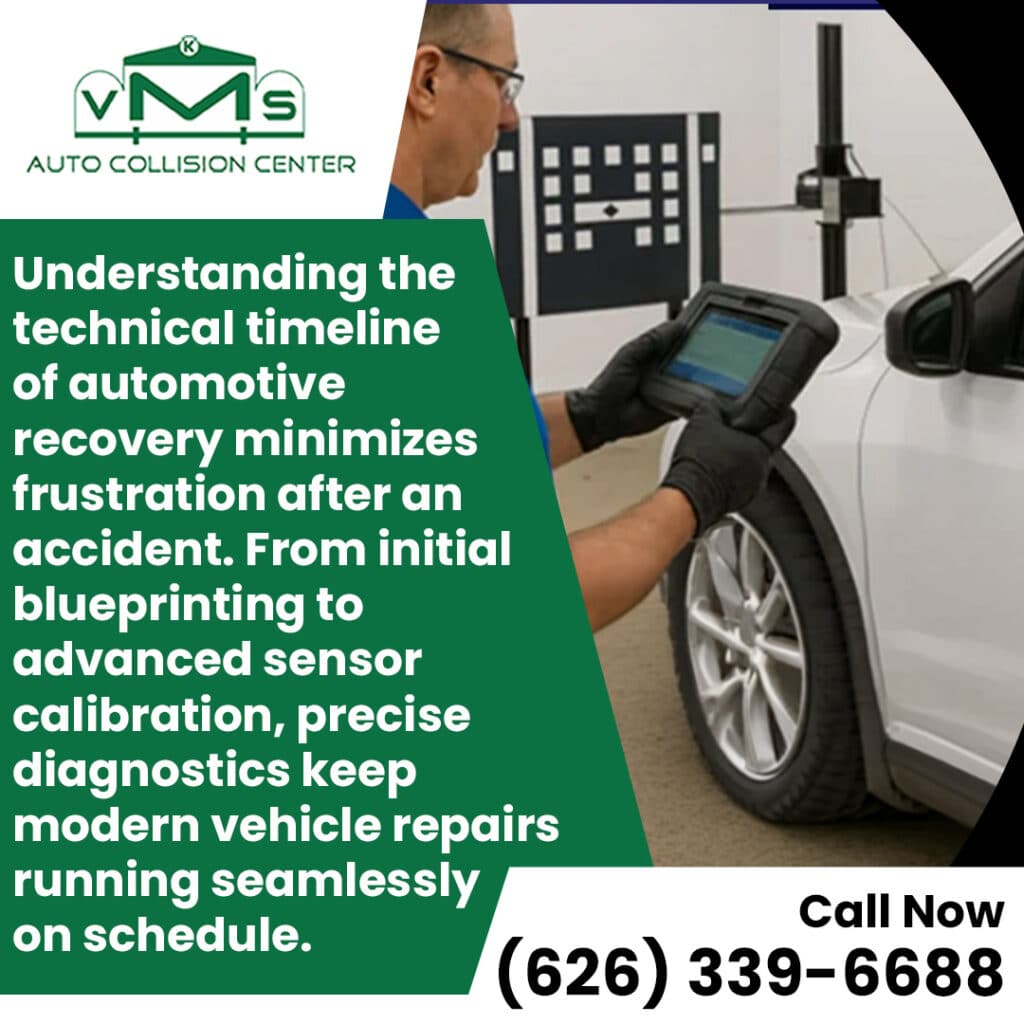
Computerized frame measurement, straightening, reassembly, and ADAS (Advanced Driver Assistance Systems) recalibration, the process of resetting sensors for features like backup cameras and automatic emergency braking, typically requires two to three weeks. More extensive structural damage, such as bent front frame rails requiring airbag module replacement, falls at the higher end of the two-to-four-week range.
Severe Damage: 4 to 8 Weeks or More
Severe damage from rollovers, head-on collisions, or significant side impacts can require four to eight weeks of active repair work. These cases involve multiple structural sections, safety system restoration, and an extensive quality control process before the vehicle is cleared for delivery.
Factors That Affect Repair Duration
Beyond the physical extent of damage, four variables consistently shape how long a vehicle remains in the shop.
Hidden Damage Identified During Disassembly
Vehicles that appear to have limited exterior damage may reveal additional structural or mechanical issues once disassembly begins. A door with a visible dent may mask a bent inner frame rail. A scraped rear bumper may conceal a displaced trunk hinge or shifted frame section.
When additional damage is identified mid-repair, a supplement, which is an updated damage estimate submitted to the insurance carrier for newly identified items, must be approved before work on those items can proceed. The frequency with which this occurs is tied directly to how thoroughly the initial inspection was conducted.
Insurance Authorization
California regulations generally require insurers to acknowledge notice of a claim within 15 calendar days and, after receiving proof of claim, accept or deny the claim in whole or in part within 40 calendar days, unless additional time is properly noticed. The review process for individual line items, including specific repair procedures and parts types, can extend beyond these windows when documentation is incomplete or disputes arise.
Submitting a detailed initial estimate, supported by diagnostic scan data and photographs, reduces the frequency of follow-up requests and moves authorization forward faster.
Parts Availability
Standard replacement parts for common vehicle makes are generally available within one to two business days. Specialty components, particularly for newer models equipped with ADAS technology, can take three to seven additional days depending on distributor inventory. OEM parts for less common vehicle models may require factory ordering, which extends the timeline further.
Parts ordering typically begins as soon as authorization is received. When required parts are identified in the initial estimate, ordering may begin during the authorization window to reduce the gap between approval and active repair work.
ADAS Sensor Recalibration
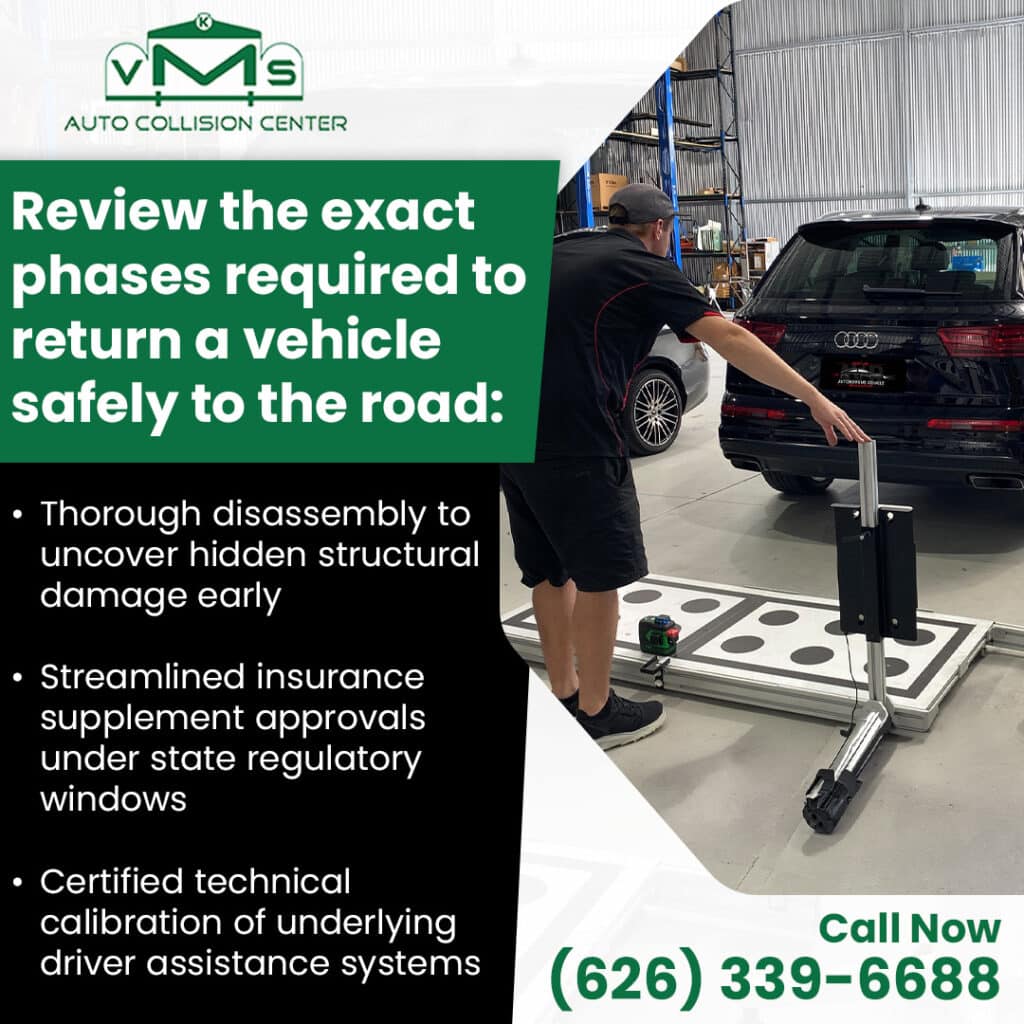
Modern vehicles rely on sensor systems that require post-repair recalibration before the vehicle is safe to return to the owner. Features such as automatic emergency braking, lane departure warnings, forward collision alerts, and adaptive cruise control all depend on sensors and cameras positioned throughout the vehicle exterior.
A collision can physically displace or damage these sensors without any visible sign of a problem. I-CAR Gold Class certification, awarded by the Inter-Industry Conference on Auto Collision Repair, requires technicians to maintain current training on ADAS recalibration procedures. Auto collision shops without that training may return a vehicle with sensors that appear functional but are operating on inaccurate data.
Automotive Collision Repair Process
Auto collision repair follows a defined sequence. Each stage produces output that the next stage depends on. Skipping or shortcutting any stage creates errors that compound later.
Stage 1: Inspection and Damage Assessment
Every repair begins with a computerized frame measurement and a full electronic system scan before any hands-on work starts.
Computerized frame measurement maps the vehicle’s structural dimensions against factory specifications. The electronic scan checks all onboard systems for damage recorded by the vehicle’s own diagnostic systems. This stage produces the written estimate submitted to the insurance carrier.
Stage 2: Insurance Authorization
California regulations set firm deadlines for insurer response and coverage decisions, which means the speed of authorization depends heavily on how complete and well-documented the initial estimate is.
At VMS Auto Collision Center, our team handles insurance communication directly. Estimates are submitted with supporting photographs and diagnostic reports. Adjuster follow-up and supplement submissions are managed by our staff, so the vehicle owner is not placed in the middle of the process.
Stage 3: Parts Ordering and Procurement
Standard parts are typically sourced within one to two business days. Specialty or ADAS-related components can add three to seven additional days.
OEM parts are used for structural and safety-critical components because they are produced to the manufacturer’s original specifications. Parts ordering begins as soon as authorization is received, and when possible, it begins during the authorization window to minimize vehicle downtime.
Stage 4: Body Repair and Paint Refinishing
Active body repair follows material-specific procedures. Paint refinishing requires controlled application and curing in a climate-stable environment before reassembly can proceed.
High-strength steel, aluminum, and composite panels each require different tools and techniques. Paint is applied inside a climate-controlled spray booth to remove variables like temperature fluctuation and airborne contaminants that affect how the finish bonds over time.
Stage 5: Reassembly and Quality Control
Reassembly typically uses OEM and certified parts installed to manufacturer-specified torque values. Quality control at this stage covers frame dimensions, panel alignment, paint finish, and all systems touched during the repair.
A thorough quality control inspection verifies that structural dimensions have been restored, panel gaps match factory tolerances, and all affected safety systems have been recalibrated and confirmed operational before the vehicle moves to the next stage.
Stage 6: Detailing and Delivery
Most shops detail the vehicle before returning it to the owner. A final review of the completed repairs gives the vehicle owner the opportunity to inspect the work, ask questions about any repair performed, and confirm the results before taking the vehicle home.
At VMS Auto Collision Center, we handle automotive collision repair as a structured, accountable process from the first inspection through the final walkthrough. We document every stage, back every repair with a written Limited Lifetime Warranty, and review every vehicle against quality standards before it leaves our shop.
Steps Owners Can Take to Avoid Delays
- File your insurance claim promptly. Many auto insurance policies require prompt notice after an accident, often within a few days, so owners should check their policy and report the incident as soon as possible. Delays in filing push back authorization and every stage that follows.
- Schedule the vehicle inspection as soon as possible. Unrepaired structural and mechanical damage worsens with regular driving. Booking an appointment early at an auto collision shop also gives technicians more lead time to source parts before the repair date, reducing downtime between authorization and active work.
- Bring complete insurance documentation to the initial appointment. Having the claim number, adjuster contact information, and policy details ready at drop-off allows the shop to begin coordination immediately.
How VMS Auto Collision Center Approaches Every Repair
Certifications That Back Our Work
Accurate damage identification from the start is one of the most reliable ways to keep an auto collision repair on schedule. VMS Auto Collision Center holds I-CAR Gold Class certification, BBB A+ accreditation maintained since October 2019, and Mazda Collision Network membership. I-CAR Gold Class requires annual, role-specific training covering current vehicle materials, structural repair procedures, and ADAS recalibration requirements. Technicians who maintain this training identify damage accurately in the first inspection, order the right parts the first time, and produce repairs that do not require rework.
Managing the Variables That Affect Your Repair Timeline
Delays in collision repair in Covina most often stem from incomplete initial estimates, slow insurance communication, and parts procurement gaps. Every vehicle we receive starts with a computerized frame measurement and a full electronic diagnostic scan, producing a thorough estimate that reduces mid-repair supplements and authorization delays. Our team handles all insurance communication directly, and rental vehicle coordination is arranged through our established provider relationships, so transportation during the repair period is not left to the owner to manage.
Our Warranty Commitment
All repairs at our auto collision shop are backed by a written Limited Lifetime Warranty covering workmanship and materials for as long as the vehicle remains in the owner’s possession. A repair completed correctly the first time removes the need for return visits. That outcome starts with trained technicians, accurate diagnosis, and a process built around accountability at every stage of automotive collision repair.
Get Your Vehicle Back on the Road
Whether your vehicle sustained minor surface damage or significant structural impact, our team is ready to assess the damage, walk you through the automotive collision repair process, and handle the insurance coordination from start to finish. Call VMS Auto Collision Center at (626) 339-6688 or email info@vmsautocollision.com to schedule your damage assessment. We serve Covina, West Covina, Glendora, Azusa, Baldwin Park, San Dimas, Irwindale, Walnut, La Puente, Pomona, and El Monte.