
A leased vehicle comes with a return deadline and a list of conditions. When the vehicle goes back to the leasing company with dents, paint damage, or bumper scuffs that exceed the contract’s wear limits, the driver absorbs the reconditioning cost. For many lessees across Covina and the San Gabriel Valley, that bill arrives as a surprise.
At VMS Auto Collision Center, we work with lessees before that point. Our auto body repair service targets the damage that triggers lease return fees, so drivers turn in their vehicles without facing charges that could have been addressed in advance. With more than three decades of certified collision repair experience, we know what lease inspectors look for and how to resolve it.
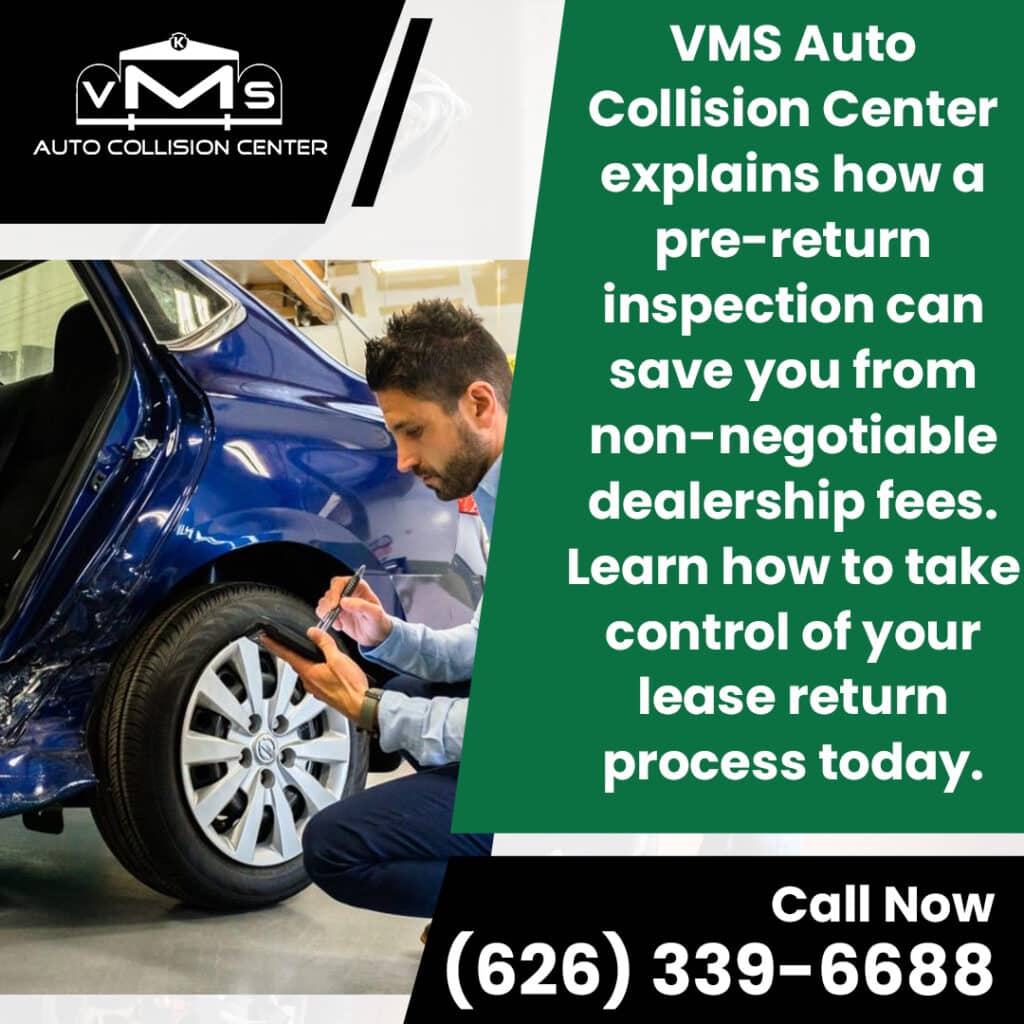
How Lease Return Inspections Work
At the end of a lease term, the leasing company schedules a third-party inspector to assess the vehicle. This inspector compares the vehicle’s condition against the wear and tear standards defined in your lease agreement’s addendum, which is a supplemental section of your lease contract that outlines acceptable damage thresholds.
The inspector documents every exterior panel, bumper, windshield, wheel, and interior surface against those thresholds. Any damage that exceeds the contract’s acceptable limits is recorded and forwarded for reconditioning charges.
Leasing companies recondition vehicles through their own vendor network before sending them to auction. Rates applied through that process are not negotiated on your behalf. Repairing damage through an independent auto body shop before the return date puts cost control back in your hands.
Leasing companies typically offer a pre-inspection in the months leading up to the return date, which is a preliminary review that gives drivers a chance to see what will be flagged before the final turn-in. Taking advantage of that window and addressing identified damage through an independent auto body shop in Covina is the most practical way to manage end-of-lease costs.
What Counts as Excess Wear and Tear
Leasing companies distinguish between normal wear and excess wear. Normal wear covers minor surface scuffs, light fading, and small marks consistent with regular use. Excess wear refers to damage that requires reconditioning before the vehicle can be resold.
Excess wear typically includes damage that is visible, structural, or beyond a defined size threshold in the lease addendum. The specific thresholds vary by brand. Reviewing your lease agreement’s wear and tear addendum before your return date shows exactly what your lessor will measure.
Exterior Damage That Gets Flagged
- Dents larger than approximately one inch across on any body panel are typically flagged. Multiple smaller dents can also accumulate into chargeable damage even if each one is individually borderline.
- Scratches that cut through the clear coat (the transparent protective layer over your vehicle’s base color) and reach the base paint or primer below are considered excess wear. Surface-level scuffs that have not broken the clear coat are more likely to pass.
- Bumper damage, which includes cracks, paint chips, and scuffs that damage more than the outer coat, is flagged consistently. Leasing companies often charge for full bumper replacement rather than a spot repair, making pre-return bumper repair at an auto body shop a worthwhile step.
- Paint chips larger than half an inch, particularly when they appear on multiple panels, will not pass a standard lease inspection.
- Windshield chips in the driver’s direct line of sight, or any chip that has spread into a crack, are flagged as a safety concern and a chargeable item.
Previously Repaired Panels With Mismatched Paint
One item many drivers overlook is a prior repair that left a visible color difference between adjacent panels. If an earlier repair was done without proper color matching, the mismatch is a chargeable item at lease return. Professional refinishing at a certified auto body shop resolves this before inspection using computerized paint-matching equipment that accounts for factory fade and UV exposure.
A Practical Pre-Return Timeline
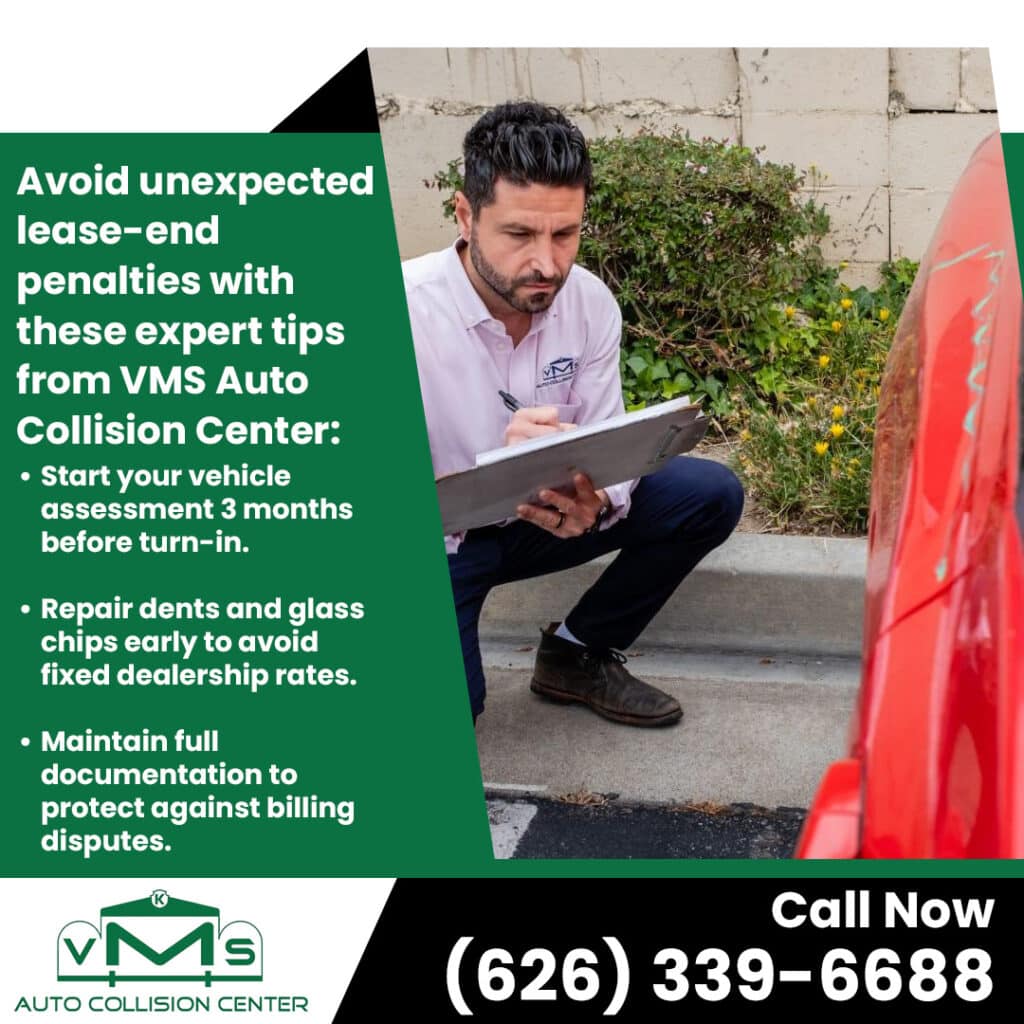
Getting ahead of the return date is what makes pre-return repair cost-effective. A rushed repair close to turn-in leaves no room to review the work or address follow-up items. Starting three months before your lease ends gives you enough time to assess, repair, and verify the work before the inspector arrives.
Three Months Before Return
Walk the vehicle in direct sunlight and from different angles. Damage that is invisible head-on often becomes visible from a low angle along the panel. Photograph everything you find for your records.
Eight to Ten Weeks Before Return
Schedule a pre-return assessment at a qualified auto body shop in Covina. A professional assessment identifies which damage will trigger charges versus which wear will pass inspection, so repair resources are directed to the right areas.
Six Weeks Before Return
Complete the auto body repairs. This allows time to review the finished work and confirm that paint color matching, panel alignment, and surface texture are consistent before the lease inspector arrives.
One to Two Months Before Return
Participate in the leasing company’s pre-inspection if offered. Items flagged there that were not already addressed can still be repaired through an independent shop at a lower cost than what the post-return reconditioning bill would reflect.
Planning for the Cost of Pre-Return Repairs
Filing an Insurance Claim vs. Paying Out of Pocket
When pre-return damage is discovered, many drivers immediately consider filing an insurance claim to cover the repair cost. In some cases, that is the right call. In others, paying out of pocket and keeping the claim off the record is the better financial decision.
The key factor is whether the repair cost exceeds your deductible. A deductible is the amount you pay before your insurance coverage applies. If the repair cost is close to or below that amount, filing a claim provides little to no financial benefit while still creating a record on the vehicle’s history.
Insurance claims are reported to vehicle history databases. A claim filed during a lease term can affect your insurance premiums at renewal and may also appear on the vehicle’s record, which the leasing company can access. For minor damage that falls within a manageable out-of-pocket range, an independent auto body repair service is often the cleaner option.
For more substantial damage, such as a collision that affected multiple panels or caused structural issues, filing a claim makes practical sense. A certified auto body shop can work directly with your insurer to manage the process from start to finish.
Financing Options for Pre-Return Repairs
For drivers who choose to pay out of pocket, the upfront cost is still a real consideration. At VMS Auto Collision Center, we offer Synchrony financing for auto body repair service, including lease return reconditioning work. Synchrony is a consumer financing program that allows approved applicants to spread repair costs over time rather than paying the full amount before return. This is particularly practical when multiple panels need attention, and the total repair scope is larger than a single out-of-pocket expense.
How Lease Return Reconditioning Works as a Service
Some auto body shops offer lease return reconditioning as a dedicated service. This is a pre-return assessment and repair process built around the standards that leasing companies apply at inspection, rather than a general cosmetic restoration.
The goal of lease return reconditioning is inspection readiness, not show-room perfection. The repair scope is determined by what the lease agreement defines as chargeable damage, which keeps the process focused and practical.
At VMS Auto Collision Center, we provide lease return reconditioning for drivers throughout Covina and the surrounding San Gabriel Valley communities. We start with a vehicle walk-around that mirrors what a lease inspector evaluates, then build a repair scope around what the lease addendum defines as chargeable.
We complete all repairs using a computerized color-matching system and professional-grade refinishing paint. This produces results that hold up under inspection and avoid issues like visible blending lines or mismatched panel texture.
Why Documentation Matters After the Repair
Repair documentation protects you beyond the repair itself. According to consumer‑guidance sources such as Kelley Blue Book, keeping detailed records of pre‑return repairs, such as invoices, photos, and repair descriptions, gives lessees a basis to question or dispute post‑return charges for damage that was professionally addressed before turn‑in.
Keep the following for every pre-return repair: a written estimate, parts receipts, and before-and-after photographs from multiple angles.
If a charge appears on a post-return bill for a panel that was repaired and documented, that paperwork demonstrates that professional work was completed prior to return. Without documentation, disputes are difficult to support, regardless of the quality of auto body repair.
At VMS Auto Collision Center, we provide written estimates, repair invoices, and before-and-after photographs with every lease return reconditioning service. This documentation gives you a clear record of all work completed before turn-in, which is your strongest protection if a dispute arises after the vehicle is returned.
Take Control Before the Lease Inspector Arrives
Lease return charges are not automatic. Most of what generates fees, including dents, scratched paint, bumper damage, and windshield chips, can be addressed before the inspector arrives at a fraction of the post-return cost. Starting three months out, identifying what will be charged, and repairing those specific items at a qualified auto body shop is the most direct way to control what you owe at turn-in.
VMS Auto Collision Center has served drivers in Covina and the surrounding areas since 1989. As an I-CAR Gold Class certified auto body shop in Covina, we carry a BBB A+ rating and Mazda Collision Network membership, credentials that reflect more than three decades of verified workmanship.
Our team handles lease return reconditioning, collision repair, paint and refinish services, and insurance claim coordination from start to finish. We also work directly with Enterprise and other rental car companies while your vehicle is in our care.
Contact VMS Auto Collision Center today at (626) 339-6688 or info@vmsautocollision.com to schedule your pre-return vehicle assessment and take the first step toward a clean lease return.