Most auto collision shops can replace a bumper. Most can blend a paint repair or pull a dent. What separates one shop from another is not the list of services posted on its website. It is what happens when the damage runs deeper than the surface, when your claim gets complicated, when you still need to get to work on Monday, and when you need someone to answer for the quality of the repair two years from now.
VMS Auto Collision Center was founded in Covina on January 10, 1989, by two brothers who believed that collision repair done right requires no shortcuts. More than 35 years later, we are still run by the same family. The founders remain active in the shop, and the next generation now leads daily operations alongside them. Three generations working under one roof is not a marketing line. It is the reason every vehicle that comes through our doors is treated with the same care we would give our own.
When your name has been on a business for over three decades, accountability is not a policy. It is personal.
What Separates a Leading Auto Collision Shop From the Rest
A leading collision repair shop is defined by three things: the ability to diagnose damage accurately, the training to restore a vehicle to manufacturer standards, and the accountability to stand behind that work over time.
Most drivers in Covina and the surrounding San Gabriel Valley have limited experience evaluating automotive collision repair facilities. Choosing a shop typically comes down to proximity, a referral from a friend, or a recommendation from an insurance adjuster. None of these filters tells you much about what actually happens to your vehicle once the keys are handed over.
The collision repair industry in California is licensed through the Bureau of Automotive Repair (BAR), which sets baseline requirements for operating a shop legally. A BAR license confirms that a shop has met the minimum legal threshold to operate. It does not measure technician training levels, equipment quality, repair accuracy, or how a shop handles a disputed insurance claim.
Beyond the license, what separates a leading collision shop from an adequate one comes down to four measurable factors.
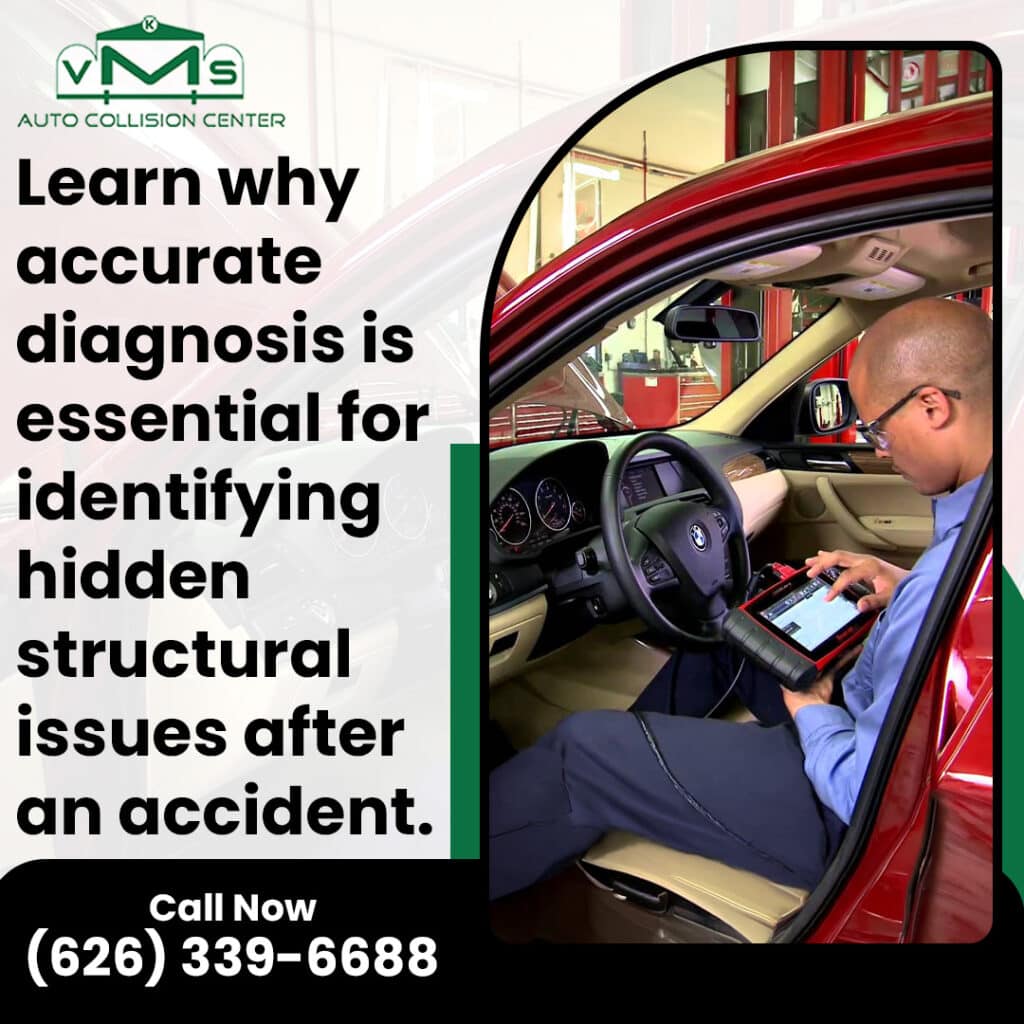
- Diagnostic capability. Structural damage to a vehicle’s frame, suspension geometry, or safety systems is frequently invisible from the outside. A shop without computerized frame measurement equipment cannot confirm whether the vehicle’s structural dimensions have been restored to factory specifications. Visual inspection alone is not sufficient.
- Material-specific repair knowledge. Modern vehicles are built from a combination of high-strength steel, aluminum, and composite materials. Each requires different tools and techniques. A shop that applies the same repair method across all materials may produce a finish that looks correct but lacks the structural integrity the vehicle was designed to provide.
- Parts quality and traceability. OEM (Original Equipment Manufacturer) parts are produced to the exact specifications used during vehicle assembly. Non-OEM parts vary in quality, fit, and durability. The type of parts a shop uses, and whether that choice is documented, affects both how the vehicle performs and what a vehicle history report reflects at resale.
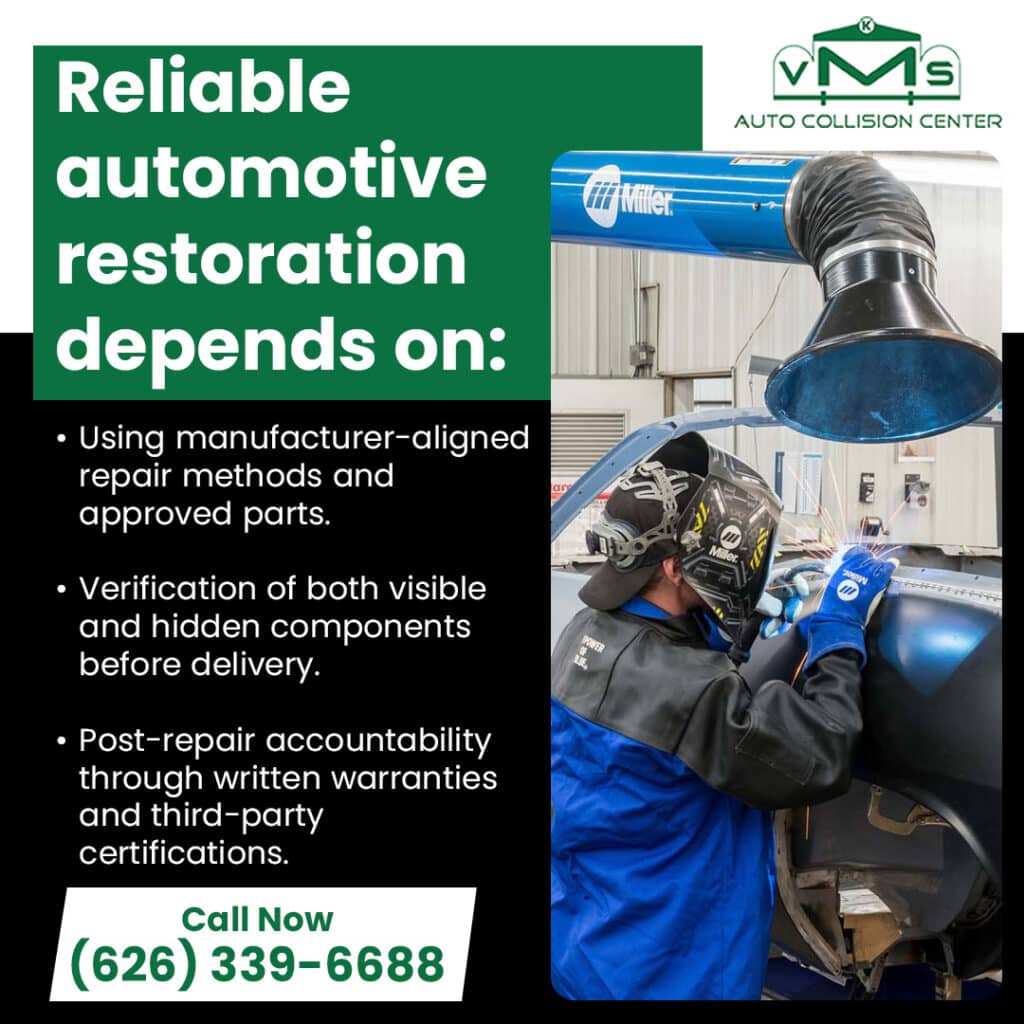
- Post-repair accountability. A warranty on repair work is a commitment that the shop will address any repair-related failure after the vehicle leaves. Without a written warranty, the customer has no documented recourse.
These four factors are the framework against which any auto collision shop in Covina should be evaluated. The sections below explain how VMS Auto Collision Center addresses each one.
The Foundation: Three Certifications, Each Earned Independently
At VMS Auto Collision Center, we hold I-CAR Gold Class certification, BBB A+ accreditation, and Mazda Collision Network membership. Each was awarded by a separate, independent organization based on documented performance.
No shop grants these to itself. That distinction matters when you are trying to evaluate a facility you have never visited before.
I-CAR Gold Class: The Training Standard Behind Every Repair
I-CAR, the Inter-Industry Conference on Auto Collision Repair, sets the training benchmark for the collision repair industry across the United States. Its Gold Class designation is the highest recognition a repair facility can earn. According to I-CAR, more than 10,000 businesses have earned this recognition out of approximately 40,000 repair shops operating in the United States, placing Gold Class facilities in a clear minority within the industry.
The reason so few shops qualify comes down to what the certification actually requires. It is not a one-time test. Every person in the shop, from the technician performing structural repairs to the estimator writing your claim, must complete role-specific training annually. When the shop stops investing in that training, the certification lapses.
For the vehicle owner, this translates into an auto collision repair team that stays current on how vehicles are actually built. A modern vehicle may use high-strength steel in its frame rails, aluminum in its hood and doors, and carbon fiber components in its body panels. Each material requires different tools, different techniques, and different quality checks. A shop without current I-CAR training may apply the wrong method and produce a repair that looks correct but performs incorrectly in a subsequent impact.
BBB A+ Accreditation: A Record of How the Shop Treats People
The Better Business Bureau (BBB) evaluates businesses based on complaint history, licensing compliance, transparency, and responsiveness to customer concerns. We have carried BBB accreditation since October 11, 2019, and hold an A+ rating, the highest available.
An A+ rating from the BBB is not about advertising spend or industry connections. It is built through a documented track record of resolving concerns fairly, operating with accurate licensing, and being honest about what a business does and does not do.
When you drop your vehicle at an auto collision shop and hand over your keys, you are extending a significant degree of trust. The BBB rating gives you a third-party record to evaluate before that moment.
Mazda Collision Network: Manufacturer-Level Evaluation
The Mazda Collision Network connects Mazda owners with repair facilities that have been evaluated directly by the manufacturer. To join, a shop must meet Mazda’s own standards for equipment, facility conditions, technician qualifications, and repair procedures.
VMS Auto Collision Center is a certified member. This means Mazda, the company that engineered these vehicles, has assessed our ability to restore them correctly. That evaluation goes beyond a state license or general business registration. It reflects how the shop performs against the standards of someone who built the car.
Six-Step Process: Accuracy Built Into Every Stage
Our repair process moves through six defined steps, from computerized structural assessment to a final customer walkthrough, with quality review built in before delivery. A defined process is not the same as a checklist stapled to a clipboard. It is a sequence where each step produces information or output that the next step depends on. Skipping or shortcutting one stage creates errors that compound later.
Inspection and Estimation: Seeing What the Eye Misses
We begin every repair with computerized frame measurement that maps your vehicle’s structural dimensions against factory specifications, identifying shifts no walk-around inspection can catch. We follow that with a full electronic scan of all onboard systems. A collision can displace sensors, cameras, and control modules without leaving a visible mark. The written estimate we produce reflects everything, not just what is visible from the outside.
Auto Body Repairs: Material-Specific Technique
We follow manufacturer-specific repair procedures based on what each vehicle is actually made of. High-strength steel cannot be treated with the same heat methods used on mild steel. Aluminum requires dedicated tools to prevent corrosion. Using the correct method for the material is not optional. It is the difference between a repair that holds and one that only looks like it does.
Painting and Refinishing: Controlled Conditions, Precise Matching
All paint work is performed using Axalta products inside a climate-controlled spray booth. Temperature, humidity, and airborne contaminants affect how paint bonds and holds over time. Our booth removes those variables. Color matching uses spectrophotometric analysis, which measures light wavelengths from your existing paint to identify the exact formulation needed, including how the color has shifted with age and sun exposure.
Reassembly With OEM Parts
OEM stands for Original Equipment Manufacturer. We use OEM and certified parts during reassembly to restore your vehicle to its pre-accident condition for fit, finish, and safety. All fasteners are installed to manufacturer-specified torque values. A bolt torqued incorrectly can back out over time or fail to hold a safety-critical component under load.
Quality Control: Verified, Not Assumed
Before any vehicle is cleared for delivery, our quality control review covers frame dimensions, panel alignment, paint finish, and the function of every system touched during the repair. The vehicle does not leave until it passes. That standard is set at the start of every job, not adjusted at the end to meet a deadline.
Detailing and Delivery Walkthrough
We fully detail every vehicle before pickup and walk you through every repair performed before you drive away. This final step gives you the opportunity to review the work firsthand and leave the shop with complete confidence in the results.
Insurance, Rental, and Financing: The Parts of the Process Nobody Warned You About
VMS Auto Collision Center manages insurance communication directly, coordinates rental vehicles through established provider relationships, and offers Synchrony financing for repair costs not covered by insurance.
The collision repair itself is only one part of what a vehicle owner has to manage after an accident. The insurance claim, transportation while the vehicle is in the shop, and out-of-pocket expenses each create their own layer of friction. At VMS Auto Collision Center, we address all of this as part of the service, not leave it for you to figure out separately.
Insurance Claim Management
We submit detailed estimates supported by photographs and diagnostic scan reports. When adjusters request supplements, when disputes arise over repair procedures, or when additional damage is found during disassembly, we handle that communication directly. You are kept informed throughout without being placed in the middle of a back-and-forth between our shop and your insurer.
California Vehicle Code Section 16000 requires drivers to file a Traffic Accident Report with the DMV within 10 days of any accident involving property damage above a defined threshold or any personal injury. Most California auto insurance policies also require notification within 24 to 72 hours. Starting the documentation process early, with professional support on your side, protects both your claim and your coverage.
Rental Vehicle Coordination
If your insurance policy includes rental coverage, we verify those benefits and coordinate vehicle pickup directly with Enterprise and other rental providers. You do not need to manage a separate phone call or figure out which rental provider your policy covers.
Synchrony Financing
Not every auto collision results in full insurance coverage. Deductibles, liability-only policies, and coverage gaps can leave some repair costs as a direct out-of-pocket expense. We help you apply for Synchrony financing so that necessary repairs can proceed on schedule rather than being deferred or reduced to fit a budget constraint.
Lease Return and the Lifetime Warranty
VMS Auto Collision Center provides lease return reconditioning services and backs all repair work with a written Limited Lifetime Warranty.
If you are approaching the end of a vehicle lease, your lessor has a defined set of return conditions. Damage that exceeds their wear-and-tear standards results in fees calculated at the dealership’s rates. Addressing exterior damage, paint condition, and visible wear through our shop before the return date puts you in control of both the repair quality and the process.
Our Limited Lifetime Warranty covers workmanship and materials on all repairs for as long as you own your vehicle, and we provide it in writing. If a repair-related issue develops after delivery, that document defines our obligation to address it. Vehicle history reports, such as CARFAX, document accident involvement alongside repair records. Repairs documented through a certified automotive collision shop and backed by a written warranty give prospective buyers verifiable evidence that your vehicle was restored correctly.
Serving Covina and the Surrounding San Gabriel Valley with Automotive Collision Repair
If your vehicle has been in an accident and you are looking for a trusted auto collision shop in Covina, our team is ready to help. Call us at (626) 339-6688 or email us at info@vmsautocollision.com to get started.