A dent on your vehicle can appear without warning. A shopping cart in a parking lot, a hailstorm, or a low-speed collision at an intersection can leave damage that is hard to ignore. Consumer dent repair kits are widely available and marketed as straightforward fixes. The reality is that auto body repair is a skilled trade, and the difference between a DIY attempt and professional auto body repair services shows in ways that affect your vehicle long after the work is done.
For more than 35 years, VMS Auto Collision Center has been the go-to destination for collision and auto body repair in Covina, CA, and the surrounding San Gabriel Valley. Our team understands what it takes to restore a vehicle properly. The sections below examine the real limitations of consumer dent kits and the specific reasons professional auto body repair produces more reliable, lasting results.
What DIY Dent Kits Are Designed to Do
DIY dent kits are built for a very limited range of damage: small, shallow, round dents with no paint damage and clear backside panel access.
Most consumer kits include a suction cup puller, a hot glue gun, plastic pull tabs, and a slide hammer. Some higher-end versions include a few metal rods. These tools apply a pulling or pushing force to move metal back toward its original position.
They work under specific conditions. The dent must be small in diameter, shallow in depth, located on a flat or gently curved panel, and the factory paint must be fully intact. When those conditions are all present, a consumer tool may produce an acceptable result on a very minor ding.
Outside those conditions, the limitations become apparent quickly. The kits cannot access metal behind reinforced body lines or double-wall panel construction. They cannot detect whether the paint has started to separate around the damaged area. They also have no way to evaluate stretched metal, which requires a different repair approach entirely and cannot be corrected through pulling force alone.
What Professional Tools Address That Consumer Kits Cannot
Professional auto body repair technicians use equipment that addresses damage at a different level of detail:
- Paint thickness gauges measure the depth of the paint system at multiple points around the damaged area. Factory paint typically measures between 4 and 7 mils thick. Readings outside that range indicate previous repairs or compromised coating that affects how the metal can be worked.
- LED lighting boards are positioned at calculated angles to reveal subtle surface deformations that are invisible under standard lighting. Technicians use these to guide metal reshaping in real time, adjusting pressure based on what the light reflection reveals about the panel surface.
- Spectrophotometers (devices that measure light wavelength to identify exact color values) account for paint fade and weathering when formulating matched paint. This matters because two vehicles with the same factory paint code can look visibly different after years of sun exposure and oxidation.
The Skill Behind Paintless Dent Repair
The quality of a dent repair depends primarily on the technician’s skill, not the tool itself. PDR (Paintless Dent Repair) is a method that reshapes metal from behind a panel without disturbing the paint surface. It preserves the factory finish when performed correctly. It requires years of practice to execute at a professional level.
A trained PDR technician reads how the metal responds to pressure continuously throughout the repair. They adjust the position, angle, and force of each tool movement based on what the metal does in real time. This is not a process that translates to a consumer kit, regardless of how detailed the instructions are.
What Happens When Pressure Is Applied Incorrectly
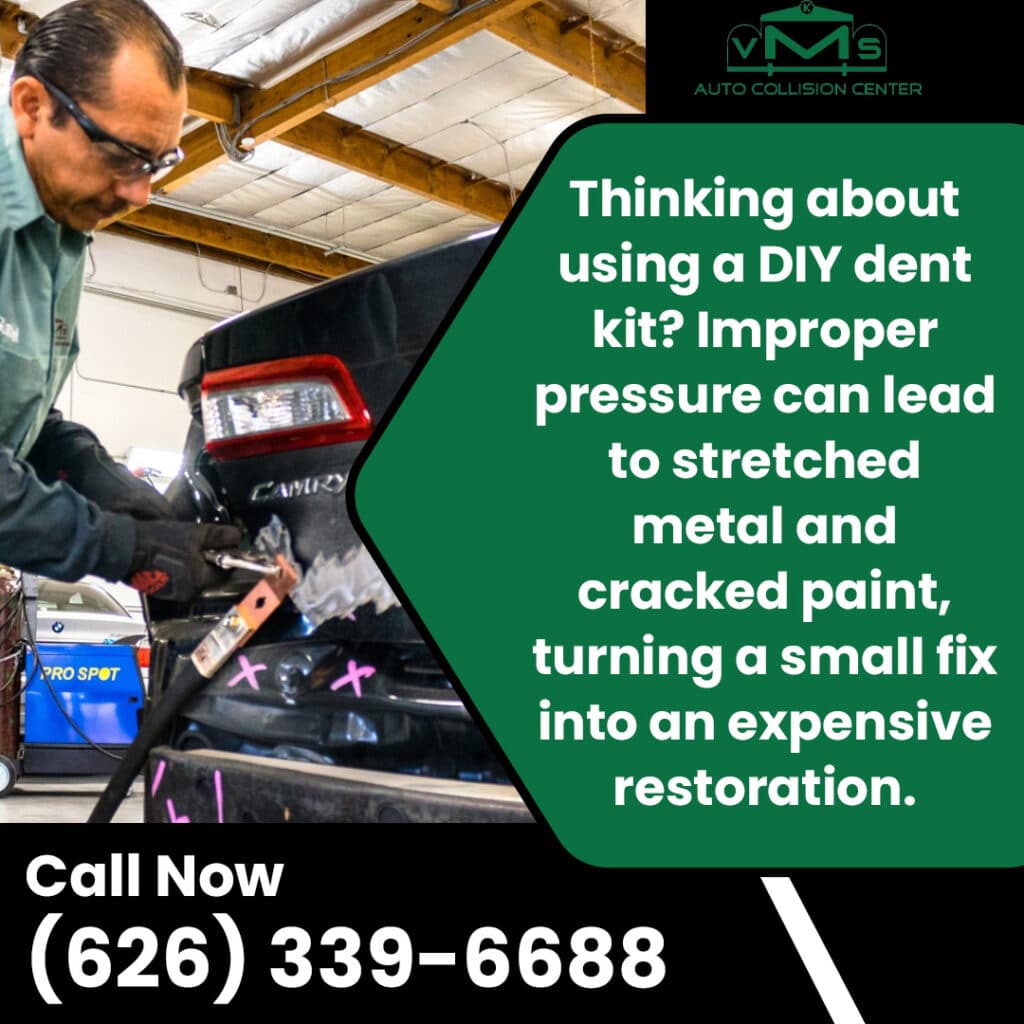
Applying force to a dent from the wrong position or with the wrong tool produces predictable problems. Pushing inward from the back of a panel at the wrong angle can deepen the original dent rather than reduce it. Pulling with too much suction from the exterior can lift the surrounding panel metal, producing a raised outline around the damage. Flexing a panel repeatedly to find the right pressure point can crack the clear coat, turning a dent-only repair into a refinishing job.
A failed DIY attempt that damages the paint or creates secondary damage around the original dent leaves the technician with more to address. The repair scope expands to cover both the initial damage and the problems introduced by the prior attempt.
Dent Locations That Require Professional Access
Some dent locations are physically inaccessible without removing interior trim panels, disassembling door components, or extracting tail light assemblies. Quarter panels often require removing the trunk liner or rear interior panels to position tools behind the damaged metal. Roof panels require access through headliner removal. Dents near body lines (the styled ridges that run along a vehicle’s exterior) are reinforced by the panel’s construction and require specific approach angles to address without cracking the paint along the crease.
A shop equipped for professional collision and auto body repair in Covina, CA, can handle all of these access requirements as part of a standard repair process. Consumer kits have no equivalent capability.
Paint Matching in Professional Auto Body Repair
Accurate paint matching requires color measurement technology that consumer products cannot replicate.
Automotive paint is a layered system. It begins with a primer coat that seals the metal and provides adhesion. A base coat carries the color. A clear coat provides gloss and protects the layers beneath it. Some finishes include additional layers, such as metallic flake, pearl pigment, or tri-coat formulations that shift color depending on the viewing angle.
Every vehicle has a factory paint code, but that code reflects the original formulation at the time of manufacture. Paint changes over time. Sun exposure fades pigment. Environmental oxidation affects gloss. A professional auto body shop measures the vehicle’s current color, not just its original specification, and formulates paint to match what is on the car now.
Why Consumer Touch-Up Paint Falls Short
Consumer touch-up products apply a factory-coded paint to the damaged area. The result is nearly always a visible patch.
- On metallic finishes, the flake orientation in professionally applied paint is controlled by spray technique and gun distance. A rattle-can application distributes flake randomly, producing a flat appearance against the directional shimmer of the original finish.
- On pearl and tri-coat finishes, the visual effect requires three separate layers applied in sequence and blended into adjacent panels. Consumer products do not replicate this process.
- On faded panels, which are common on older vehicles or those with frequent sun exposure, touch-up paint matched to the factory code appears lighter or brighter than the surrounding finish. The patch becomes more visible than the actual damage.
At VMS Auto Collision Center, we color-match every panel that requires refinishing using a computerized paint mixing system with Axalta paint products. We account for the vehicle’s current finish rather than its original code alone, blending the repair into surrounding panels for a result that is difficult to distinguish from the factory finish.
Hidden Damage Beneath the Surface
Visible dent damage does not always reflect the full extent of an impact. Crumple zones in modern vehicles are engineered sections of the frame and body structure designed to absorb collision energy and protect the passenger compartment. A dent in or near a crumple zone can indicate that the zone has partially engaged, even when the surface damage appears minor. A crumple zone that has deformed no longer performs as designed in a subsequent impact.
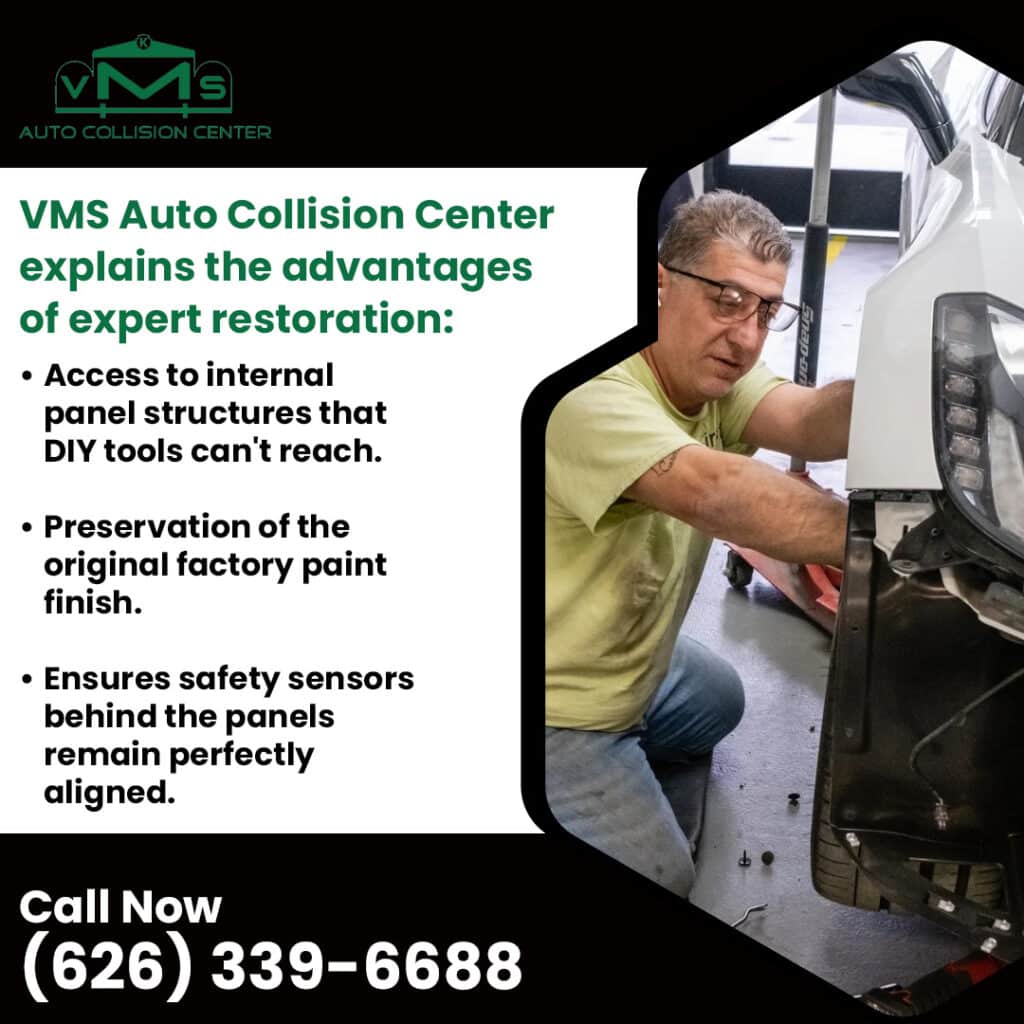
Today’s vehicles also carry driver assistance technology positioned behind body panels and bumpers. This includes parking sensors, backup cameras, blind-spot monitoring radar, adaptive cruise control sensors, and forward collision warning systems. A panel that has shifted even slightly from its original position can misalign these systems, producing false alerts or degraded performance without any visible sign of the problem.
Professional Inspection Identifies What Visual Assessment Misses
Professional auto body repair services include a systematic inspection before any repair begins. At VMS Auto Collision Center, Step 1 of our 6-step repair process is a thorough inspection and estimation phase that evaluates both the surface damage and the structural and mechanical systems beneath it.
Computerized measuring systems compare vehicle dimensions against manufacturer specifications. These measurements identify structural shifts that are not visible from the surface. Electronic system scans check sensor calibration and identify components that require recalibration after repair.
Consumer kits have no inspection capability. They address only what is visible on the surface, which is not always the complete picture of the damage.
How Professional Auto Body Repair Protects Your Investment
Effect of Repair Quality on Vehicle Value
A well-maintained exterior directly affects what a vehicle is worth at trade-in or resale. Visible dent damage or uneven paint work signals neglect, giving buyers a basis to push for a lower offer at the point of sale or trade-in.
A failed DIY repair only deepens that impression. Buyers and appraisers are trained to identify non-factory paint work. A visible color mismatch, a wavy surface, or an uneven texture signals that the vehicle has been repaired outside a professional shop. This raises questions about what else may have been addressed the same way and gives buyers grounds to negotiate a lower price.
Professional repair performed by a certified body shop in Covina and documented in the vehicle’s service history produces a verifiable repair record. The finish matches. The surface is smooth. The repair holds up to appraisal.
Certifications That Distinguish Professional Auto Body Shops
Certification indicates that the technicians at an auto body shop have met verified industry training and quality standards.
I-CAR Gold Class Certification
I-CAR Gold Class is the collision repair industry’s highest training recognition, awarded by the Inter-Industry Conference on Auto Collision Repair. It requires technicians to complete ongoing education across structural repair, mechanical and electrical systems, and refinishing procedures.
Manufacturer Network Certification
Manufacturer collision network programs connect vehicle owners with auto body shops that meet the automaker’s own standards for quality and safety. These programs require shops to follow brand-specific repair procedures, use approved parts, and maintain equipment that meets manufacturer specifications. Repairs performed within these networks are held to the standards set by the vehicle’s original maker.
VMS Auto Collision Center holds I-CAR Gold Class certification and is part of the Mazda Collision Network. Each of these credentials is independently verifiable and reflects the level of training and accountability behind the work performed at our body shop in Covina.
The Warranty Distinction
Professional auto body repair services are backed by written warranties. DIY kits carry no such protection.
A warranty means that if the repair fails, shows workmanship defects, or develops problems after the vehicle leaves the shop, the customer has documented recourse. At VMS Auto Collision Center, every repair is covered by a Limited Lifetime Warranty, valid for as long as you own the vehicle.
Consumer kits offer no equivalent. If a DIY attempt cracks the paint, leaves a raised ring around the original dent, or produces a wavy surface, correcting the result falls entirely on the vehicle owner.
Recommended First Step After Any Dent
A professional damage assessment is the appropriate first step after any dent, before attempting any repair method.
A professional inspection takes 15 to 30 minutes. It identifies the full scope of damage, including anything beneath the surface, establishes the correct repair method, and provides a documented estimate. It removes the guesswork from the decision about how to proceed.
At VMS Auto Collision Center, we provide thorough damage assessments to identify the full scope of your vehicle’s condition before any repair begins. Our team identifies whether PDR, traditional bodywork, or structural repair is the appropriate approach for your specific damage and explains the reasoning clearly before any work begins.
Schedule a Free Damage Assessment in Covina
When you are ready to take the next step, VMS Auto Collision Center is here to help. Contact us at (626) 339-6688 or info@vmsautocollision.com to schedule your damage assessment for collision and auto body repair in Covina, CA. We are open Monday through Friday, 8 am to 5 pm, and Saturdays by appointment.