
A door ding in a parking lot, a hailstorm that hits overnight, or a minor fender tap at an intersection are the kinds of dents that leave vehicle owners wondering whether a repaint is necessary. The answer starts with one major factor: the condition of the existing paint at the point of impact. From there, technicians also evaluate dent depth, metal stretch, panel access, and prior repair history. A dent with fully intact paint can often be corrected through paintless dent repair (PDR), a method that reshapes the metal from behind the panel without touching the finish. A dent where the paint has cracked or chipped requires a process that includes refinishing.
At VMS Auto Collision Center, our team has been providing auto body repair services to drivers in Covina and the surrounding San Gabriel Valley since 1989. As a family-owned body shop with over three decades of hands-on experience, we assess each vehicle individually to determine the correct repair method before any work begins, whether that means PDR, traditional refinishing, or a targeted combination of both.
Paint Condition as the Primary Determining Factor
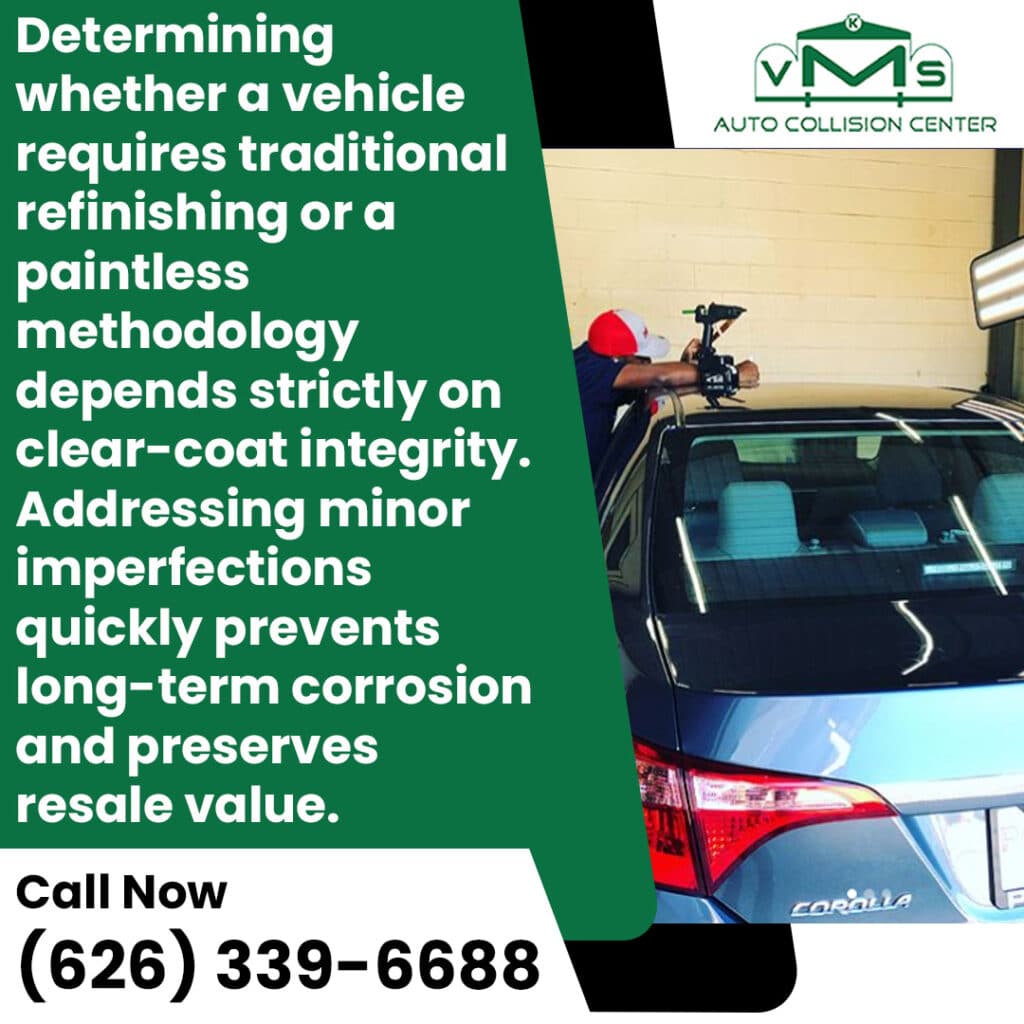
The repair method for any dent is determined first by whether the paint remains structurally intact.
Automotive paint is not a single layer. Factory paint systems commonly include corrosion protection, primer, basecoat that carries the color, and clear coat layers that provide gloss and protect the layers beneath it. Some finishes, such as pearl, metallic, and tri-coat formulations, include additional layers that shift in appearance depending on the viewing angle.
When a dent occurs, the metal deforms inward or outward. If the paint system flexes with the metal without cracking, the surface coating remains a continuous protective barrier. A trained technician can work the metal back toward its original position through PDR without disturbing the paint.
When the impact force exceeds the paint’s flexibility, the clear coat or base coat cracks at the point of contact. Even a hairline crack not visible to the naked eye exposes bare metal to air and moisture. At that point, refinishing becomes a necessary part of the repair.
Paintless Dent Repair: Method and Application
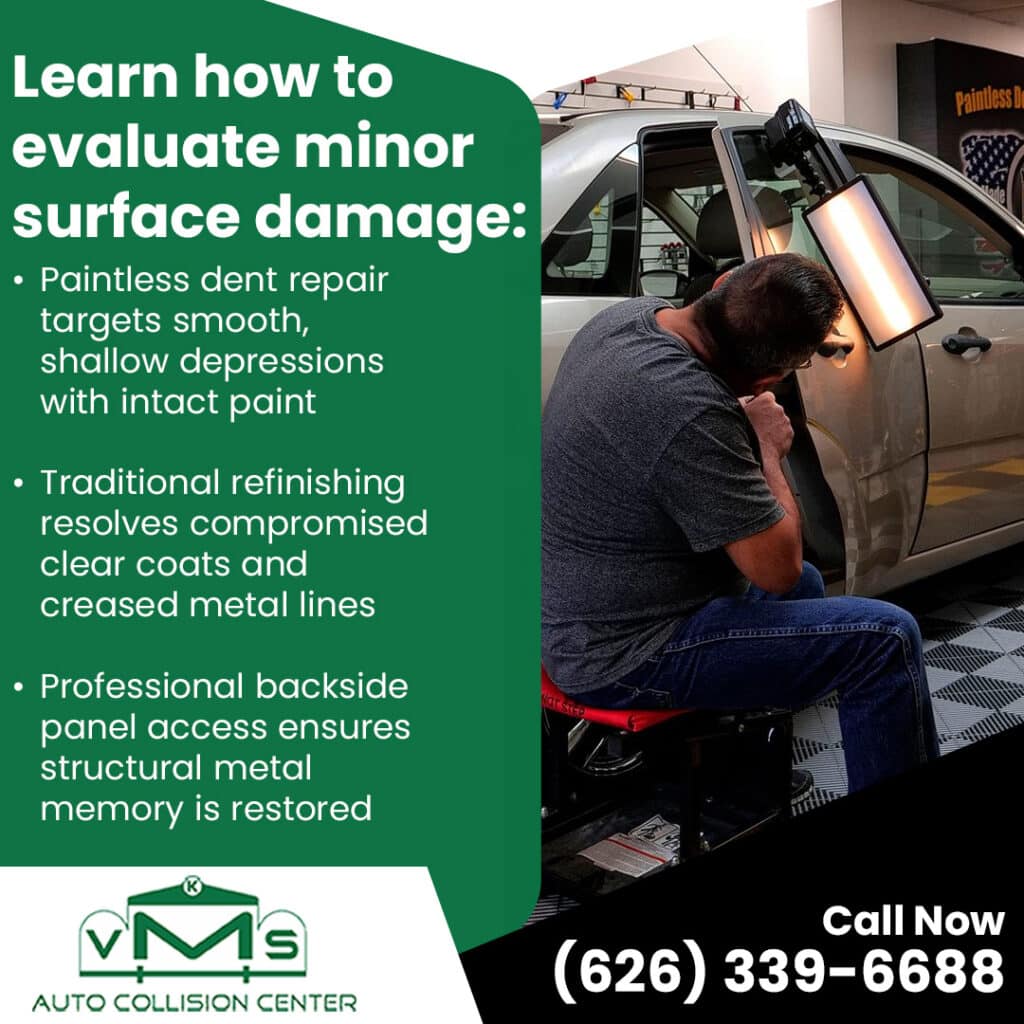
PDR is a technique that removes dents by accessing the back side of a body panel and gradually reshaping the metal without sanding, body filler, or paint.
Technicians insert specialized metal rods and picks through access points behind the damaged panel and apply controlled pressure from the inside outward. The process requires continuous visual feedback. LED lighting boards positioned at precise angles allow technicians to read how the panel surface responds to each movement, adjusting pressure and position throughout the repair.
Because the original paint stays in place, PDR eliminates the risk of color mismatch. Every vehicle’s finish weathers and fades at its own rate over time, and matching a weathered factory color is a precise undertaking. PDR bypasses that challenge entirely.
Dent Types Where PDR Applies
PDR is the appropriate repair method when the damage falls into one of the following categories:
- Round, shallow depressions from door dings in parking lots
- Small hail impacts where the paint surface remains intact
- Minor fender contacts that leave a smooth depression without creasing the metal
- Low-speed parking lot impacts on flat panel sections away from body lines
Conditions That Require Traditional Auto Body Repair
Repainting becomes necessary when paint integrity is lost, when metal has stretched beyond PDR limits, or when panel construction prevents backside tool access.
Traditional auto body repair involves reshaping the metal mechanically, applying body filler (a two-part polyester compound used in thin layers to smooth surface irregularities after metalwork), sanding progressively through multiple grit levels, and refinishing with matched paint. When the damage calls for it, this is the complete and correct repair path.
Situations That Require Repainting
- The paint has cracked, chipped, or separated at the impact point.
- The dent falls along a sharp body line, where the panel shape may make controlled metal movement more difficult.
- Metal stretching has pushed the deformation beyond what backside pressure can fully correct.
- Backside panel access is restricted by vehicle construction, such as roof panels requiring headliner removal or quarter panels requiring trunk liner disassembly.
- A prior repair in the same area left aftermarket paint that is less flexible than factory coating and more likely to crack under PDR movement.
When any of these conditions are present, the vehicle requires traditional repair to be restored correctly. VMS Auto Collision Center delivers professional auto body repair in Covina, CA, applying the right method for each damage type so the finished result meets both safety and appearance standards.
How Panel Location Affects the Repair Approach
Where a dent sits on a vehicle determines backside accessibility, which directly affects whether PDR is possible. Different panel locations carry distinct structural characteristics and access requirements.
Door Panels
Door panels are generally the most PDR-accessible area on a vehicle. Access is gained by removing the interior door trim panel, which allows clear tool positioning directly behind the outer skin. Door dings are among the most common repairs at a body shop and are frequently good PDR candidates when the paint is intact.
Hood and Roof Panels
Hood panels are accessible from the engine compartment on most vehicles, though structural bracing and insulation can affect tool angles near the hood’s outer edges. Roof panels require headliner removal to reach the back side. This adds disassembly time but does not rule out PDR if the paint is intact and the dent geometry is compatible.
Quarter Panels and Bumper Covers
Quarter panels, the body sections between the rear wheel well and the trunk, often require removing the trunk liner or rear interior trim to position tools correctly. Dents near the wheel arch may have limited backside access.
Bumper covers are constructed from thermoplastic materials, not steel or aluminum. PDR tools are designed for metal panels. Bumper repair follows a process involving heat reshaping, adhesive compounds, and refinishing rather than PDR.
How Professional Assessment Determines the Repair Method
A professional inspection at a Covina auto body shop can identify damage conditions that visual observation alone cannot detect.
Paint that appears intact to the eye may carry hairline clear coat fractures that become visible only under directional LED lighting or paint thickness measurement. Metal that looks like a simple round depression may have stretched at the point of impact in a way that changes which tools and techniques apply.
Paint Thickness Gauges
Paint thickness gauges measure the depth of the existing paint system at multiple points around the damaged area. Factory paint typically measures between 4 and 7 mils thick. Readings outside that range may suggest prior refinishing, unusually thin coating, excessive material buildup, or other conditions that require closer inspection.
LED Lighting Boards
LED lighting boards positioned at calculated angles cast shadows across the panel surface, revealing deformations invisible under flat overhead lighting. Technicians use these to guide tool movement and identify stress patterns in the metal before and during the repair.
At VMS Auto Collision Center, damage assessment is the first step in our six-step repair process. Our technicians evaluate paint condition, dent depth and shape, panel accessibility, and metal stress before determining the correct auto body repair services needed and producing a written estimate. No work begins until the repair path is established and explained.
Paint Matching in Repairs That Require Refinishing
When repainting is required, accurate color matching depends on measuring the vehicle’s current paint, not its original factory code.
Every vehicle carries a factory paint code that reflects the original color formulation at the time of manufacture. Over time, sun exposure fades pigment, and oxidation affects gloss. A vehicle’s finish after several years of use differs measurably from the original factory specification. Relying on the factory code alone often results in a visible color difference on the repaired panel.
Spectrophotometer Measurement
Repair facilities use a spectrophotometer, a device that measures light wavelength values at multiple points across a vehicle’s surface, to account for current color rather than original specification. The reading produces a color formula adjusted for the vehicle’s actual finish at the time of repair.
Panel Blending
Refinished panels are blended into adjacent surfaces through a process of feathering new paint outward across neighboring panels, creating a gradual transition rather than a sharp boundary between repaired and original areas.
VMS Auto Collision Center uses a computerized paint mixing system with Axalta paint products. For many color-matched refinishing repairs, especially metallic, pearl, and multi-stage finishes, blending into adjacent panels may be needed to create a seamless transition.
How Dent Repair Affects Resale and Trade-In Value
Professionally repaired dents, documented in a vehicle’s service history, have a lower impact on resale value than unrepaired damage or visible non-factory repair work. Buyers and dealership appraisers inspect vehicle exteriors during trade-in and private sale evaluations. Visible color mismatches, wavy panel surfaces, and uneven textures indicate non-factory work and give buyers grounds to reduce offers.
PDR and Factory Finish Preservation
PDR preserves the original factory finish entirely. Because no new paint is applied, there is no color variation and no surface texture change. When performed successfully on a suitable dent, PDR can leave the repaired area visually indistinguishable from an undamaged panel.
Vehicle condition grading directly affects trade-in value. Edmunds notes that a vehicle with a considerable number of scratches or dings falls below the “clean” condition threshold, reducing what a dealer is willing to offer at appraisal. Professional repair with documented warranty coverage provides verifiable proof of completed auto body repair services, supporting the vehicle’s value at the point of resale.
Dent Repair Services at VMS Auto Collision Center
At VMS Auto Collision Center, the repair method is determined by what each vehicle’s damage actually requires. Our team performs both PDR and traditional auto body repair in Covina, CA, with every decision backed by a thorough inspection before any work begins.
PDR for Paint-Intact Dents
For dents with intact paint, accessible panel backs, and metal that has not stretched beyond correction, our technicians perform PDR to restore the panel without disturbing the original factory finish.
Traditional Repair for Paint-Damaged Dents
For dents involving paint damage, creased metal along body lines, or restricted panel access, we perform traditional repair: metal reshaping, body filler, primer, and computerized color-matched paint blended into adjacent panels.
Targeted Approach for Mixed Damage
For vehicles with mixed damage, where some panels have intact paint, and others show cracking, PDR is applied to qualifying areas, while refinishing is applied only where paint damage requires it.
As a trusted Covina auto body shop with over 35 years of service to the San Gabriel Valley, all repair work is backed by a Limited Lifetime Warranty, valid for as long as you own your vehicle. Our team holds I-CAR Gold Class certification, the collision repair industry’s highest training recognition, and carries a BBB A+ rating. We serve drivers throughout Covina, West Covina, Glendora, Azusa, Baldwin Park, San Dimas, Irwindale, Walnut, La Puente, Pomona, and El Monte.
Professional Dent Repair in Covina Starts With the Right Assessment
A professional inspection is the correct first step before choosing a repair method, deciding whether a small cosmetic repair should go through insurance, and authorizing any work. At VMS Auto Collision Center, our team evaluates every vehicle individually and walks you through the findings before any work is scheduled. Contact us at (626) 339-6688 or info@vmsautocollision.com to schedule your assessment for auto body repair in Covina, CA.